Hvar's Butterflies

Marion Podolski casts her expert artistic eye over Hvar's butterflies.

Hvar butterfly at work, July 2016 Hvar butterfly at work, July 2016 Vivian Grisogono

Butterflies always seem so fragile, so transient. So it came as quite the surprise when I read that (a) there are butterfly fossils dating back around 56 million years, and (b) the Painted Lady appears to hold the record for the longest return migration, from Africa to the Arctic circle and back!
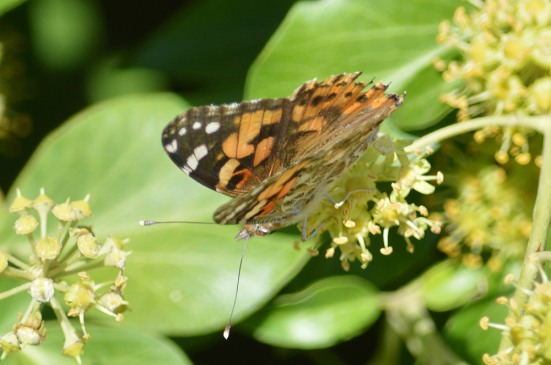
Painted lady

Vanessa cardui ~ Painted lady ~ Stričkovac

This photograph was taken at Vorh on Hvar, altitude around 500 metres. European ivy is known for having flowers high in nectar, and was swarming with butterflies and bees in September. The Painted lady migrates from North Africa and the Mediterranean northwards in the springtime, and southwards in the autumn. The 9,000 mile round trip between tropical Africa and the Arctic circle may take as many as 6 generations! Was this butterfly on a refuelling stop for its Autumn migration?

This summer I’ve been more aware of butterflies on Hvar, possibly due to my recent interest in wildflowers. It’s a good sign, as flowers and butterflies mean a healthy ecosystem. Though sometimes they were nowhere near any flowers!
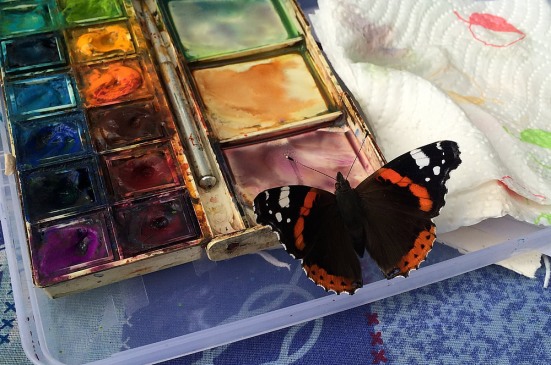
Red admiral

Vanessa atalanta ~ Red Admiral ~ Ljepokrili admiral

As I was sitting on the Soline beach near Vrboska, painting with my art group, this visitor was very interested in my paintbox! Luckily I had my phone to hand, and managed to capture the moment! And as I didn’t really feel that paints were proper nourishment, being toxic and all, I closed up the box, so it decided to try some wine instead!
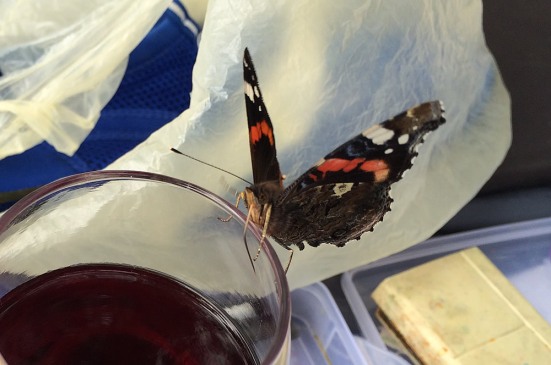
Red admiral likes a glass of wine

My Red admiral likes a glass of wine!

While some (adult) butterflies live only for a few days, other species survive for almost a full year. Those living longer can feed on nectar from flowers, and they are in fact important pollinators for some kinds of plants. Although they can’t carry as much pollen as bees, they are able to take it over longer distances. They’ll also sip water (and wine!), are sometimes  attracted to dung, rotting fruit, or the salt in human sweat for other essential minerals and nutrients. Their “taste” receptors are apparently located on their feet, so they can determine whether a leaf is suitable for laying eggs on (ie the caterpillar kids can eat it!)
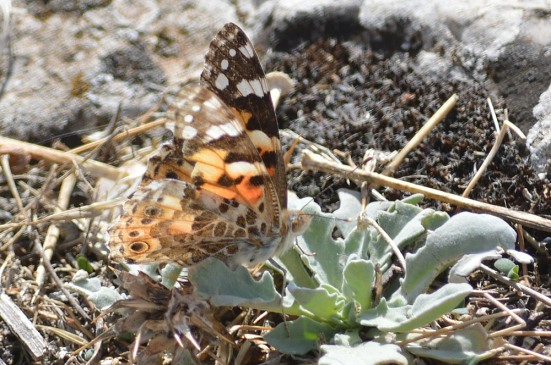
Red admiral underside

Red admiral underside

I spotted this Red admiral near the peak of Sv Nikola, up in the high country (628 metres). Good view of the underside of the wing. Red admirals also migrate, spending summer in northern Europe, and winter near the Mediterranean.

In Croatian, a butterfly is called a leptir, for once easy to remember as it’s clearly related to lepidoptera (from the ancient Greek  lepís=scale + pterón=wing). It’s less certain why the English saw any association with butter, though the name has been around for some time in old Dutch and German. Were there only yellow butterflies in northern Europe, I wonder?
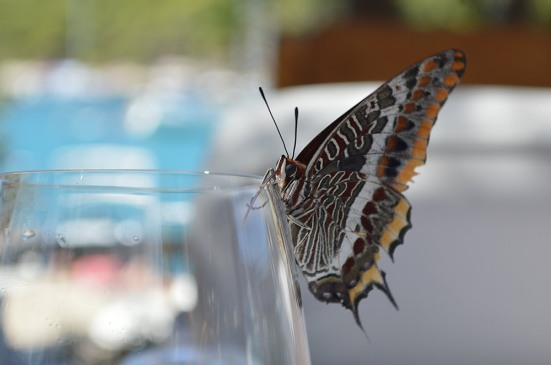
Two-tailed pasha also going for my wine

Charaxes jasius ~ Two-Tailed Pasha ~ vještica

Another butterfly that was keen to share our wine was this Two-tailed Pasha with exceptional taste at restaurant Laganini on Palmižana! It did, in fact, take a dive headfirst into my glass and had to be rescued at the expense of the wine!
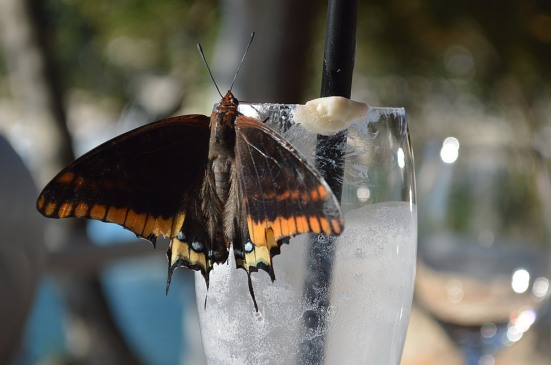
Two-tailed pasha

Two-Tailed Pasha enjoying some lemon sorbet

A fine butterfly, and a great poser with his proboscis stuck into a drop of lemon sorbet (with vodka and prosecco) for a good long drink! Two-tailed pashas produce two generations in a season, flying May/June and August/October. Clearly, they also like a drink!
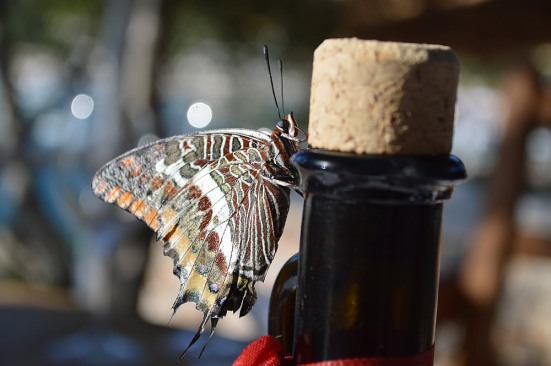
Two-tailed pasha underside

Two-tailed pasha underside and clear view of head

The beautiful colour of butterfly wings is due to the scales. While the dark blacks and browns are melanin pigments, and yellows come from uric acid and flavones, the other bright blues, greens, reds and iridescence are all caused by the structure of the scales and hairs.
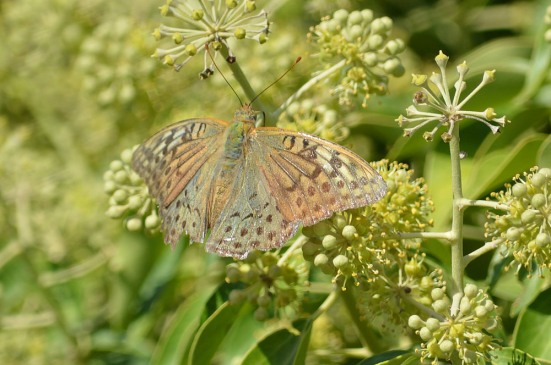
Cardinal

Argynnis pandora ~ Cardinal ~ Pandorin šarenac

Meanwhile, back at the popular ivy flowers, was this lovely Cardinal which is a fairly common butterfly around southern Europe from April to September. Sadly the photograph doesn’t quite do justice to the shimmer of that pale green colour. Very pretty in real life!
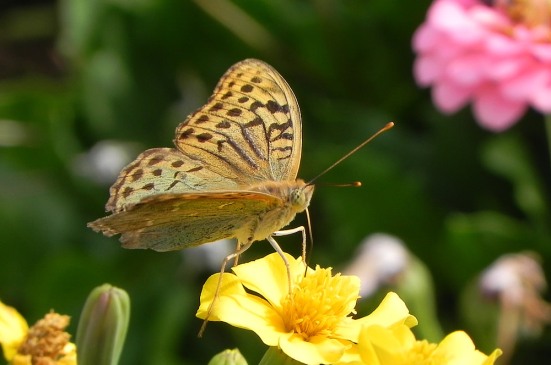
Cardinal in Stari Grad

Cardinal in Stari Grad

The second Cardinal was spotted in a garden in Stari Grad. Good view of the antennae, and the proboscis stuck into the flower. It looks to have only 4 legs, but that’s apparently normal for some types of butterflies, the front two legs are much reduced.
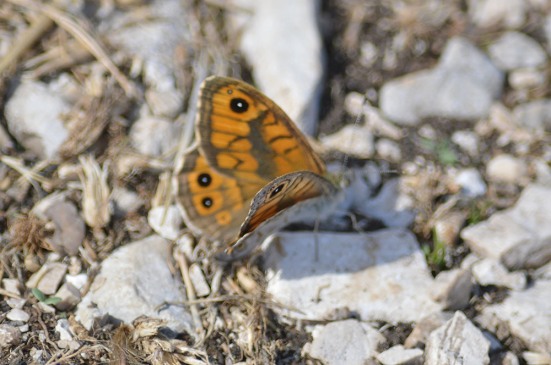
Wall brown

Lasiommata megera ~ Wall Brown ~ mali pjegavac

Hmmm, the field notes say the Wall brown is very alert and difficult to approach for taking photos – well, that’s certainly true! This guy was spotted beside the path on the way up to Sv Nikola, and this is the best photograph I could manage!

A recent (2011-13) study of butterflies on Hvar recorded 49 species, some of which are very rare within Croatia. All in all, 57 species have been recorded on Hvar, giving it 4th place among the islands for butterfly diversity. I have a long way to go to spot all those!

“Happiness is a butterfly, which when pursued, is always just beyond your grasp, but which, if you will sit down quietly, may alight upon you.”
~ Nathaniel Hawthorne

© Marion Podolski 2016

More about Croatia’s butterflies:

Project Noah: Butterflies and Moths of Croatia

Euro Butterflies by Matt Rowlings

Wikipedia list of butterflies and moths in Croatia

Annoted list of Croatian butterflies with vernacular names (PDF file for download)

Contribution to the knowledge of the butterfly fauna on the Adriatic island of Hvar, Croatia

This article has been reproduced with kind permission from Marion's blog Go Hvar, Ramblings about a far island. Visit the blog for all kinds of information about Hvar, from artistic to epicurean!

Nalazite se ovdje: Home Novosti iz prirode Hvar's Butterflies

Novosti: Ekologija.hr

  • Ex-energy secretary Ed Miliband’s agenda appears undermined as money is diverted from renewables to defence

    Britain is unlikely to hit its targets on green heating after the cuts announced by John Healey this week, experts have warned, as critics of Ed Miliband claim the former energy secretary’s green agenda is being dismantled.

    The chancellor unveiled more than £3bn worth of cuts to the energy department’s budget this week, much of which will pay for higher defence spending.

    Continue reading...

  • This week’s best wildlife photographs from around the world

    Continue reading...

  • Turkey has been hit by powerful thunderstorms and a fatal tornado this week with more heavy rain expected

    Heavy rain and strong winds will continue to affect parts of south-eastern Europe and Turkey over the next few days, as an area of low pressure in the region has allowed for the formation of powerful thunderstorms. During a particularly intense thunderstorm in Antalya, a coastal city in the south-west of Turkey, the formation of a tornado resulted in the deaths of four construction workers on Tuesday. Authorities in Greece and Turkey have released severe rainfall and flooding warnings, as a further 100-150mm (nearly 4-6in) of rain is expected this week in central Greece and western parts of Turkey, with locally higher totals possible.

    Travelling eastwards towards south Asia, strong winds and heavy rainfall have swept across the Indian regions of Odisha and Andhra Pradesh as Cyclone Arnab made landfall. With wind gusts in excess of 85mph (140km/h) and rainfall totals in some regions exceeding 200mm, the severe storm has prompted mass evacuations of more than 180,000 people, as well as widespread disruption to energy and transport infrastructure. The cyclone will weaken as it continues to traverse northwards over the coming days, though will continue to deliver heavy rain to parts of northern and central India as it does so.

    Continue reading...

  • After UK’s hottest summer on record, Ardingly near Haywards Heath is just 19% full – and next-closest reservoir is unusable due to broken treatment works

    “You can see the water level at Ardingly going down and down. I don’t remember ever seeing it this low,” says Caroline Allan, a lifetime resident of Haywards Heath, the nearest town to one of England’s most depleted reservoirs.

    The Ardingly reservoir, managed by South East Water and serving about 95,000 properties in and around Haywards Heath and Uckfield in Sussex, is currently 19% full.

    Continue reading...

  • Scientists call for incentives to preserve vegetation as study highlights benefits of plentiful planting in London

    Your front garden could be a first line of defence against air pollution, according to a year-long field study in two London neighbourhoods.

    The UK’s 26m gardens cover nearly 5% of the country’s land area, but they account for a much larger share in urban areas. In Greater London, domestic gardens cover 41% of the city, compared with 27% of Cardiff and 23% of Edinburgh.

    Continue reading...

  • In this week’s newsletter: There are too many meetings, and not enough decisions, say experts – and time is running out

    • Don’t get Down to Earth delivered to your inbox? Sign up here

    When things are not going well at an environmental summit, organisers often tell delegates that the “world is watching” in an attempt to focus minds. But spend any time at biodiversity Cop17 in Armenia and it is clear that the world’s attention is elsewhere.

    The negotiating halls of Yerevan’s Meridian centre are subdued. Environment ministers have arrived from all corners of the world to plan their response to being so far behind the biodiversity targets they agreed four years ago. Right now, they appear on track to miss nearly all of them. They risk continuing the miserable record of never having met a biodiversity target they have set for themselves.

    The climate crisis will destroy our economies – we learned this 20 years ago. When will we act?

    Heat killed ‘staggering’ 50,000 people in Europe’s cities this summer, scientists warn

    Angry Labour MPs urge leadership not to overrule energy secretary on Rosebank

    Continue reading...

  • As many as 8 million people have been affected by food shortages, electricity blackouts and health clinic closures

    Extreme drought driven by an historic El Niño is affecting as many as 8 million people in Papua New Guinea, causing a cascade of issues from shortages of food and water, to electricity scarcity and schooling disruption.

    An influential coalition that includes churches, trade unions and business groups has said the Pacific nation is in the midst of a “national crisis”, but there appears to be “no coordinated plan to protect vulnerable communities from the worsening impacts of El Niño.”

    Continue reading...

  • Keen to join in the revelry but don’t have a costume? You can still fashion a get-up without buying – or wasting – anything

    • Change by degrees offers life hacks and sustainable living tips each Saturday to help reduce your household’s carbon footprint

    • Got a question or tip for reducing household emissions? Email us at [email protected]

    The thrill of an event like Halloween doesn’t come from a brand new costume or “two pillowcases’ worth of sweets”, says play specialist Cat Sewell.

    The fun comes from carving out the time to play, making ridiculous outfits, and the terror and delight of haunting the neighbourhood, says the artistic director and co-CEO of Polyglot Theatre, a company that creates participatory, immersive, child-led theatre.

    Continue reading...

  • There is no end in sight for the drivers of illegal mining, while police action appears ineffective

    Cora Bailey has been encountering illegal miners ever since she first started treating injured animals in the townships around Roodepoort, west of Johannesburg, in 1991. But as the price of gold has soared, so too has activity in the abandoned mine shafts that mark the area.

    In late September, dozens of zama zamas – the name given to illegal miners in South Africa, meaning roughly “to take a chance” in Zulu – arrived to dig for gold across the dirt road from her charity, Claw (Community Led Animal Welfare).

    Continue reading...

  • Replacing diesel-powered ferries with electric vessels could reduce emissions and improve air quality

    Cutting through New York Harbor in the shadow of the Statue of Liberty, the small white boat we were riding on caught the attention of passengers aboard a nearby sightseeing ferry.

    “It’s quite a curiosity at the moment,” Eric Laakmann, the chief executive and co-founder of Vessev, said.

    Climate Central is an independent group of scientists and communicators who research and report the facts about our changing climate and how it affects people’s lives.

    Continue reading...

Novosti: Cybermed.hr

Novosti: Biologija.com