Hvar's Butterflies

Marion Podolski casts her expert artistic eye over Hvar's butterflies.

Hvar butterfly at work, July 2016 Hvar butterfly at work, July 2016 Vivian Grisogono

Butterflies always seem so fragile, so transient. So it came as quite the surprise when I read that (a) there are butterfly fossils dating back around 56 million years, and (b) the Painted Lady appears to hold the record for the longest return migration, from Africa to the Arctic circle and back!
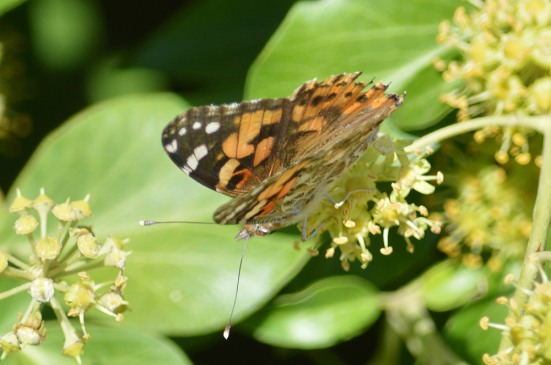
Painted lady

Vanessa cardui ~ Painted lady ~ Stričkovac

This photograph was taken at Vorh on Hvar, altitude around 500 metres. European ivy is known for having flowers high in nectar, and was swarming with butterflies and bees in September. The Painted lady migrates from North Africa and the Mediterranean northwards in the springtime, and southwards in the autumn. The 9,000 mile round trip between tropical Africa and the Arctic circle may take as many as 6 generations! Was this butterfly on a refuelling stop for its Autumn migration?

This summer I’ve been more aware of butterflies on Hvar, possibly due to my recent interest in wildflowers. It’s a good sign, as flowers and butterflies mean a healthy ecosystem. Though sometimes they were nowhere near any flowers!
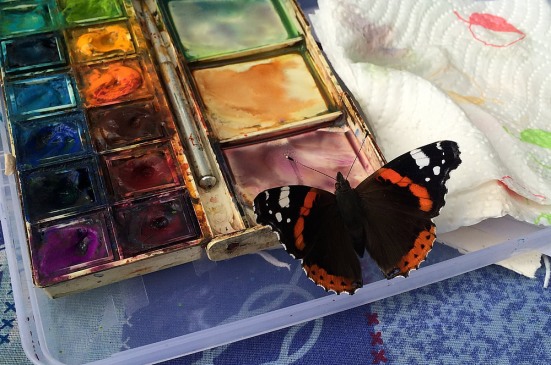
Red admiral

Vanessa atalanta ~ Red Admiral ~ Ljepokrili admiral

As I was sitting on the Soline beach near Vrboska, painting with my art group, this visitor was very interested in my paintbox! Luckily I had my phone to hand, and managed to capture the moment! And as I didn’t really feel that paints were proper nourishment, being toxic and all, I closed up the box, so it decided to try some wine instead!
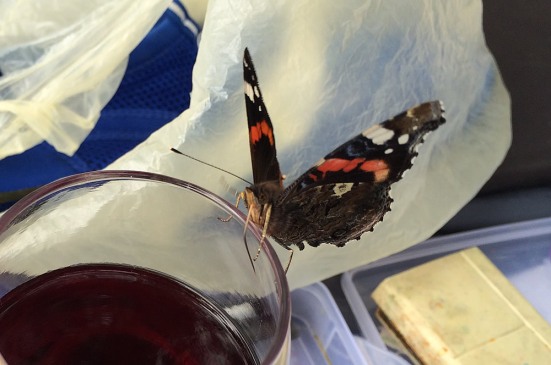
Red admiral likes a glass of wine

My Red admiral likes a glass of wine!

While some (adult) butterflies live only for a few days, other species survive for almost a full year. Those living longer can feed on nectar from flowers, and they are in fact important pollinators for some kinds of plants. Although they can’t carry as much pollen as bees, they are able to take it over longer distances. They’ll also sip water (and wine!), are sometimes  attracted to dung, rotting fruit, or the salt in human sweat for other essential minerals and nutrients. Their “taste” receptors are apparently located on their feet, so they can determine whether a leaf is suitable for laying eggs on (ie the caterpillar kids can eat it!)
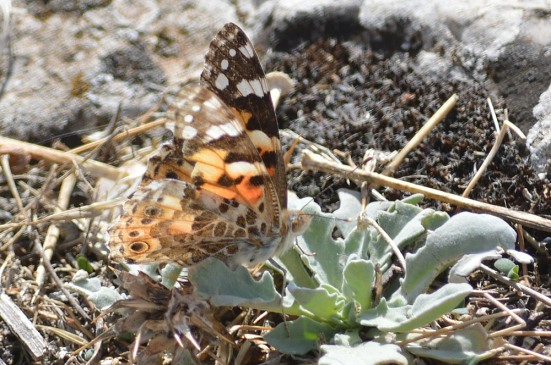
Red admiral underside

Red admiral underside

I spotted this Red admiral near the peak of Sv Nikola, up in the high country (628 metres). Good view of the underside of the wing. Red admirals also migrate, spending summer in northern Europe, and winter near the Mediterranean.

In Croatian, a butterfly is called a leptir, for once easy to remember as it’s clearly related to lepidoptera (from the ancient Greek  lepís=scale + pterón=wing). It’s less certain why the English saw any association with butter, though the name has been around for some time in old Dutch and German. Were there only yellow butterflies in northern Europe, I wonder?
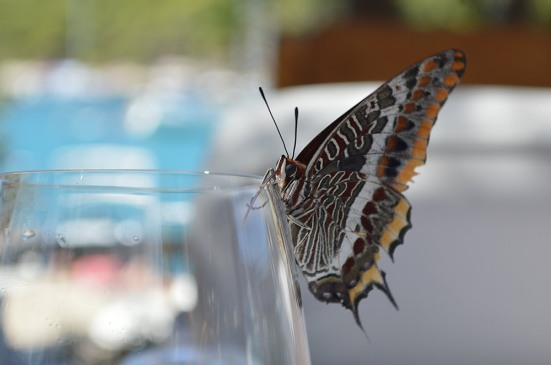
Two-tailed pasha also going for my wine

Charaxes jasius ~ Two-Tailed Pasha ~ vještica

Another butterfly that was keen to share our wine was this Two-tailed Pasha with exceptional taste at restaurant Laganini on Palmižana! It did, in fact, take a dive headfirst into my glass and had to be rescued at the expense of the wine!
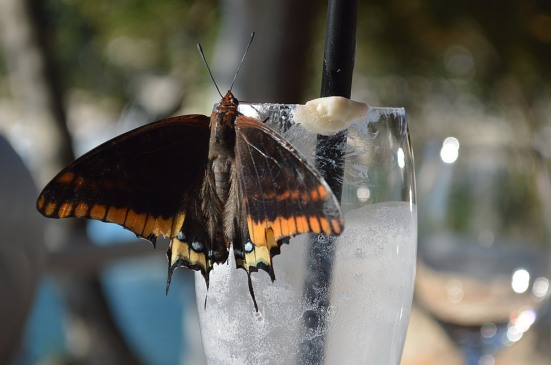
Two-tailed pasha

Two-Tailed Pasha enjoying some lemon sorbet

A fine butterfly, and a great poser with his proboscis stuck into a drop of lemon sorbet (with vodka and prosecco) for a good long drink! Two-tailed pashas produce two generations in a season, flying May/June and August/October. Clearly, they also like a drink!
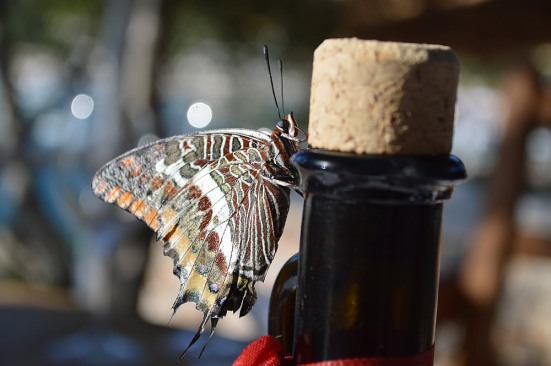
Two-tailed pasha underside

Two-tailed pasha underside and clear view of head

The beautiful colour of butterfly wings is due to the scales. While the dark blacks and browns are melanin pigments, and yellows come from uric acid and flavones, the other bright blues, greens, reds and iridescence are all caused by the structure of the scales and hairs.
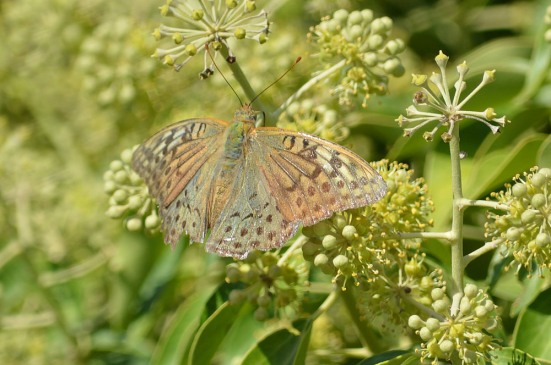
Cardinal

Argynnis pandora ~ Cardinal ~ Pandorin šarenac

Meanwhile, back at the popular ivy flowers, was this lovely Cardinal which is a fairly common butterfly around southern Europe from April to September. Sadly the photograph doesn’t quite do justice to the shimmer of that pale green colour. Very pretty in real life!
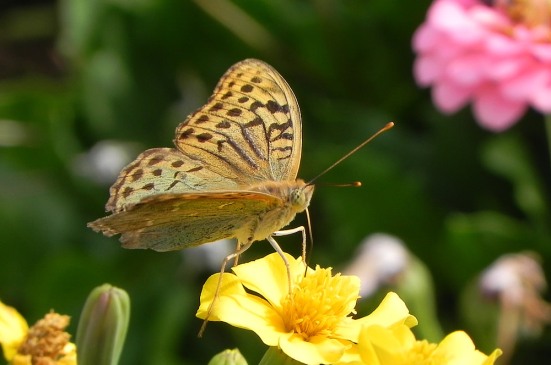
Cardinal in Stari Grad

Cardinal in Stari Grad

The second Cardinal was spotted in a garden in Stari Grad. Good view of the antennae, and the proboscis stuck into the flower. It looks to have only 4 legs, but that’s apparently normal for some types of butterflies, the front two legs are much reduced.
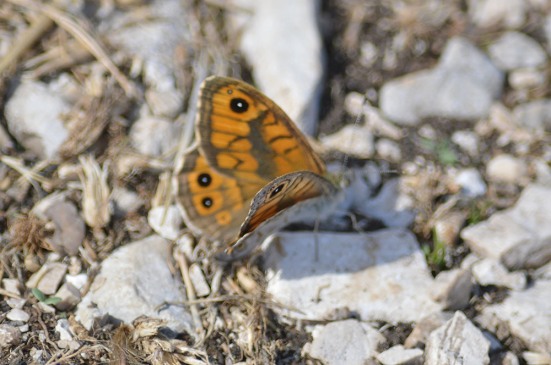
Wall brown

Lasiommata megera ~ Wall Brown ~ mali pjegavac

Hmmm, the field notes say the Wall brown is very alert and difficult to approach for taking photos – well, that’s certainly true! This guy was spotted beside the path on the way up to Sv Nikola, and this is the best photograph I could manage!

A recent (2011-13) study of butterflies on Hvar recorded 49 species, some of which are very rare within Croatia. All in all, 57 species have been recorded on Hvar, giving it 4th place among the islands for butterfly diversity. I have a long way to go to spot all those!

“Happiness is a butterfly, which when pursued, is always just beyond your grasp, but which, if you will sit down quietly, may alight upon you.”
~ Nathaniel Hawthorne

© Marion Podolski 2016

More about Croatia’s butterflies:

Project Noah: Butterflies and Moths of Croatia

Euro Butterflies by Matt Rowlings

Wikipedia list of butterflies and moths in Croatia

Annoted list of Croatian butterflies with vernacular names (PDF file for download)

Contribution to the knowledge of the butterfly fauna on the Adriatic island of Hvar, Croatia

This article has been reproduced with kind permission from Marion's blog Go Hvar, Ramblings about a far island. Visit the blog for all kinds of information about Hvar, from artistic to epicurean!

Nalazite se ovdje: Home Novosti iz prirode Hvar's Butterflies

Novosti: Ekologija.hr

  • Emissions from exported oil would not count against carbon budget, insiders say – reasoning likely to draw dismay from climate campaigners

    The giant Rosebank oilfield can be approved without breaching the UK’s emission targets, according to government insiders, in a boost to those in the cabinet who are pushing for it to be given the go-ahead.

    The Guardian revealed last week that Miatta Fahnbulleh, the energy secretary, was leaning towards rejecting the project, but her position has put her at loggerheads with cabinet colleagues, including the chancellor, John Healey, who are lobbying for an approval.

    Continue reading...

  • Scientists uncover ancient hills and swamps that disappeared as sea levels rose across northern Adriatic

    Venice is famed for being a floating city, but research shows the land it sits on once lay many miles inland. Dramatic changes in sea level over 10,000 years have reshaped the northern Adriatic coastline, with much of the land that our ancestors roamed now lying beneath the waves.

    Samuele Ongaro, at the University of Southampton, and colleagues combined seismic data with sedimentary cores from the coastal basins of northern Italy, Slovenia and northern Croatia to model changes in sea level across the region and reconstruct past landscapes over the past 10,000 years.

    Continue reading...

  • The radical Stern report showed that a low-carbon future is also good economics. But it seems that capitalism needs a reminder

    Saving the only planet we have makes good economic sense. There is, after all, no money to be made on a dead Earth. There may be costs involved now, but they are worth paying to protect our children from certain destruction.

    These propositions seem self-evident now. But two decades ago, mainstream economists had very different ideas. They had proved that the climate crisis would be a mere economic blip, easily absorbed by growing economies and therefore not worth spending money on. In their accounting, they considered ice caps and glaciers functionally worthless, that trees only add to GDP when they are cut down, and that a livable climate shouldn’t even merit a line on a spreadsheet.

    Fiona Harvey is an environment editor at the Guardian

    Continue reading...

  • Extreme heat accelerated disappearance of Triglav glacier from mountain revered as a symbol of Slovenian identity

    The final ice patch has vanished from Slovenia’s Triglav glacier, the latest Alpine casualty of Europe’s scorching summer.

    The once mighty ice mass lost 93% of its surface area between 1983 and 2003, shrinking to cover less than a hectare of overheated rock, but went on to surprise researchers who feared its imminent demise, clinging on to the mountain for two more decades.

    Continue reading...

  • A striking transformation takes place along the coast of Qinqdao in autumn, when a native seepweed turns a brilliant shade of red.

    The ‘red beach’ phenemon can be seen in the salt marshes and wetlands on the coast of China’s Shandong province, where the Suaeda glauca plantmatures and absorbs water, changing it from green to crimson between September and November

    Continue reading...

  • Wharram and York, North Yorkshire: It’s the nervy few days before a ceremony that will honour our local waterways, and I have work to do

    I visit the source of the tiny stream called the Gypsey Race now and then, drawn by the everyday miracle of its water welling to catch sunlight like a plaything and alchemise it into colours and sparks. Today, though, is different, because I’ve come to ask for something. Something like permission, or approval maybe.

    I’ve been helping to organise a gathering of river advocates to co-draft a regional charter of river rights – making explicit our responsibilities towards them. We will be holding a ceremony to blend waters from across Yorkshire to make ink in which the charter will be written. I want to collect water from the Gypsey, but I also want some of its potent reputation. Its course is regarded as auspicious thanks to an extraordinary concentration of nearby prehistoric barrows, cursuses and henges, not to mention England’s tallest standing stone. Local folklore insists that its capricious flow holds the power of prophecy.

    Continue reading...

  • Chris Packham says £24bn earmarked for projects with ‘ludicrously uncertain results’ should be redirected to help lower bills and cut emissions

    Campaigners are calling on the chancellor to cut the government’s £24bn spending plans for “fairytale” carbon capture technologies in favour of funding green schemes that can reliably cut emissions and lower energy bills.

    The environmentalist Chris Packham is leading an 11th-hour appeal for the Treasury to use this week’s budget to scale back the government’s “exorbitantly expensive” support for carbon capture, which is now more than the planned spending for the US, the EU, Norway and Japan combined.

    Continue reading...

  • Here are some of our writers’ best ways to stay toasty and occupied, even during cold weather, from teas to pajamas

    When the weather starts to take a turn for the brisk, the impulse to stay inside and hibernate is nothing new – but there are ways to optimize your time spent inside for maximum coziness and pleasure.

    From a limited-edition candle to a plush, furry comforter that does double duty, here are some of the ways our writers stay toasty even when the weather outside turns frightful.

    Continue reading...

  • In wet weather, garden snails can seek shelter in letterboxes – and find a feast there waiting for them

    We’ve all heard of snail mail – a term popularised since the advent of electronic mail – but who knew that snails eat mail? It might sound far-fetched but it’s true.

    We have it on good authority from the ecologist Simon Mustoe, who said snails ate his letter from Sir David Attenborough, a BBC report announcing the closure of a Northumberland Royal Mail postbox because of snails “munching the mail”, and desperate people on the forums of the Australian hardware chain Bunnings claiming snails have “a real appetite for postal letters” and can “eat a whole letter in two days”.

    Continue reading...

  • My mother was a keen swimmer, and she lived with depression. I wonder if she found the same respite in the water that has helped heal me since she passed away

    It was early morning in late September, off the coast of Kaş in Turkey. Watching the slightly choppy sea from a boat, the last thing I felt like doing was embarking on another 5km (3-mile) swim. Mind fog had sapped my energy, and my mood was decidedly Eeyore-like. But as I pulled on my cap and flippers, adjusted my goggles and took the plunge, something shifted.

    Head in the water, the knotted feeling in my throat began to loosen. Breathing came properly. There was respite.

    Continue reading...

Novosti: Cybermed.hr

Novosti: Biologija.com