Hvar's Butterflies

Marion Podolski casts her expert artistic eye over Hvar's butterflies.

Hvar butterfly at work, July 2016 Hvar butterfly at work, July 2016 Vivian Grisogono

Butterflies always seem so fragile, so transient. So it came as quite the surprise when I read that (a) there are butterfly fossils dating back around 56 million years, and (b) the Painted Lady appears to hold the record for the longest return migration, from Africa to the Arctic circle and back!
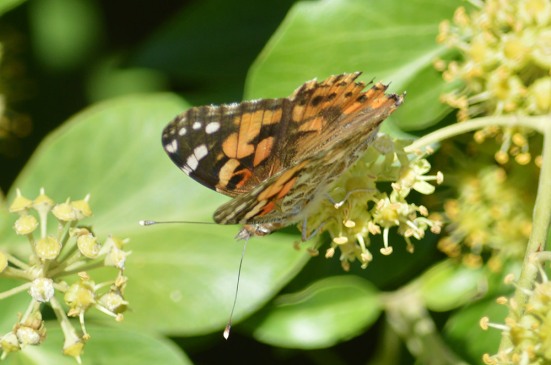
Painted lady

Vanessa cardui ~ Painted lady ~ Stričkovac

This photograph was taken at Vorh on Hvar, altitude around 500 metres. European ivy is known for having flowers high in nectar, and was swarming with butterflies and bees in September. The Painted lady migrates from North Africa and the Mediterranean northwards in the springtime, and southwards in the autumn. The 9,000 mile round trip between tropical Africa and the Arctic circle may take as many as 6 generations! Was this butterfly on a refuelling stop for its Autumn migration?

This summer I’ve been more aware of butterflies on Hvar, possibly due to my recent interest in wildflowers. It’s a good sign, as flowers and butterflies mean a healthy ecosystem. Though sometimes they were nowhere near any flowers!
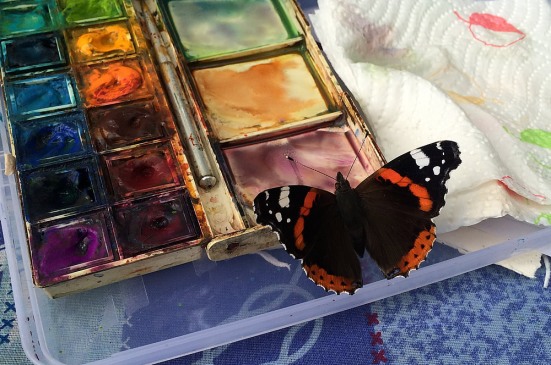
Red admiral

Vanessa atalanta ~ Red Admiral ~ Ljepokrili admiral

As I was sitting on the Soline beach near Vrboska, painting with my art group, this visitor was very interested in my paintbox! Luckily I had my phone to hand, and managed to capture the moment! And as I didn’t really feel that paints were proper nourishment, being toxic and all, I closed up the box, so it decided to try some wine instead!
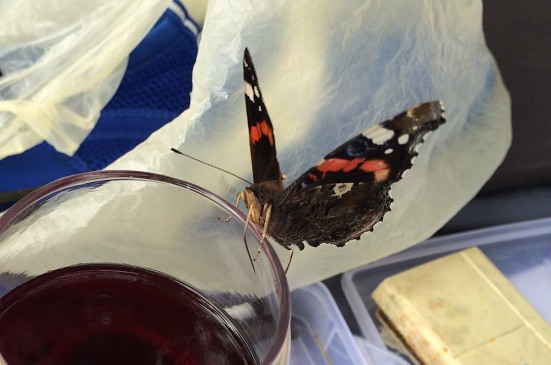
Red admiral likes a glass of wine

My Red admiral likes a glass of wine!

While some (adult) butterflies live only for a few days, other species survive for almost a full year. Those living longer can feed on nectar from flowers, and they are in fact important pollinators for some kinds of plants. Although they can’t carry as much pollen as bees, they are able to take it over longer distances. They’ll also sip water (and wine!), are sometimes  attracted to dung, rotting fruit, or the salt in human sweat for other essential minerals and nutrients. Their “taste” receptors are apparently located on their feet, so they can determine whether a leaf is suitable for laying eggs on (ie the caterpillar kids can eat it!)
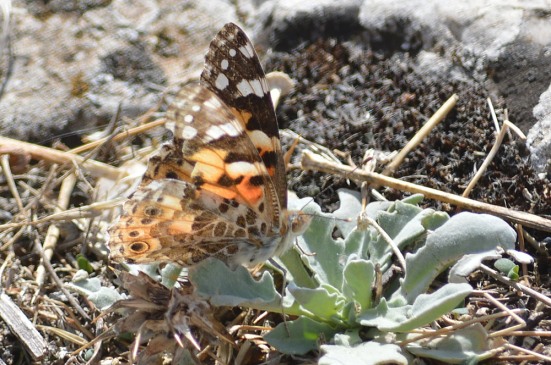
Red admiral underside

Red admiral underside

I spotted this Red admiral near the peak of Sv Nikola, up in the high country (628 metres). Good view of the underside of the wing. Red admirals also migrate, spending summer in northern Europe, and winter near the Mediterranean.

In Croatian, a butterfly is called a leptir, for once easy to remember as it’s clearly related to lepidoptera (from the ancient Greek  lepís=scale + pterón=wing). It’s less certain why the English saw any association with butter, though the name has been around for some time in old Dutch and German. Were there only yellow butterflies in northern Europe, I wonder?
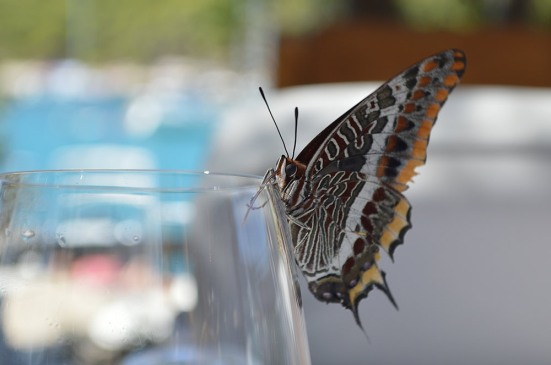
Two-tailed pasha also going for my wine

Charaxes jasius ~ Two-Tailed Pasha ~ vještica

Another butterfly that was keen to share our wine was this Two-tailed Pasha with exceptional taste at restaurant Laganini on Palmižana! It did, in fact, take a dive headfirst into my glass and had to be rescued at the expense of the wine!
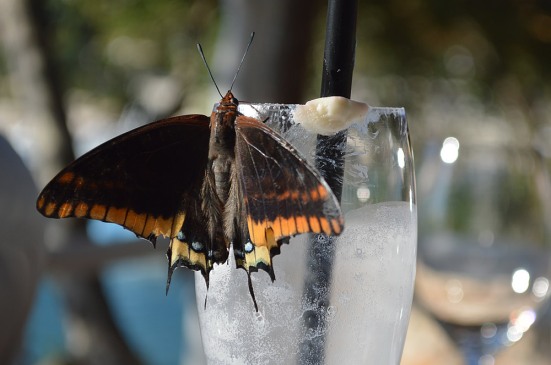
Two-tailed pasha

Two-Tailed Pasha enjoying some lemon sorbet

A fine butterfly, and a great poser with his proboscis stuck into a drop of lemon sorbet (with vodka and prosecco) for a good long drink! Two-tailed pashas produce two generations in a season, flying May/June and August/October. Clearly, they also like a drink!
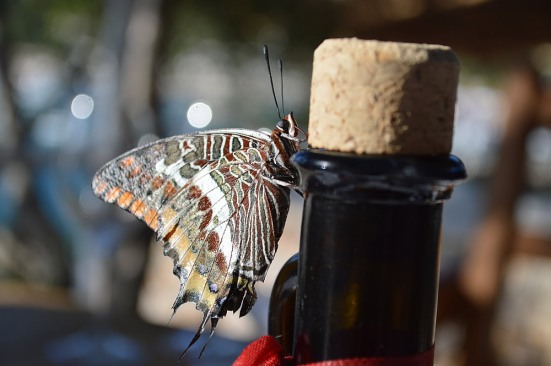
Two-tailed pasha underside

Two-tailed pasha underside and clear view of head

The beautiful colour of butterfly wings is due to the scales. While the dark blacks and browns are melanin pigments, and yellows come from uric acid and flavones, the other bright blues, greens, reds and iridescence are all caused by the structure of the scales and hairs.
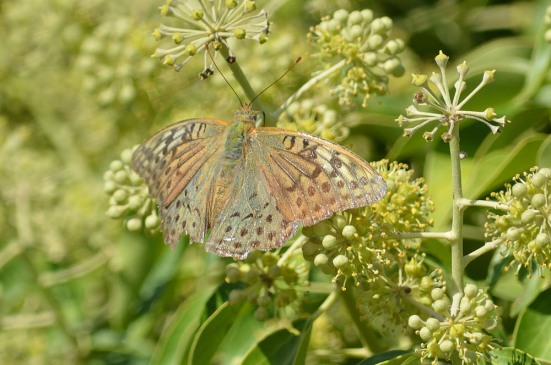
Cardinal

Argynnis pandora ~ Cardinal ~ Pandorin šarenac

Meanwhile, back at the popular ivy flowers, was this lovely Cardinal which is a fairly common butterfly around southern Europe from April to September. Sadly the photograph doesn’t quite do justice to the shimmer of that pale green colour. Very pretty in real life!
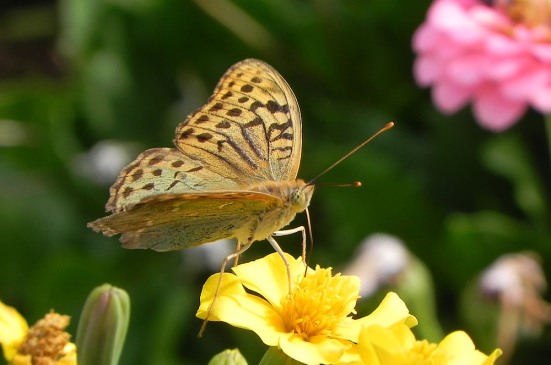
Cardinal in Stari Grad

Cardinal in Stari Grad

The second Cardinal was spotted in a garden in Stari Grad. Good view of the antennae, and the proboscis stuck into the flower. It looks to have only 4 legs, but that’s apparently normal for some types of butterflies, the front two legs are much reduced.
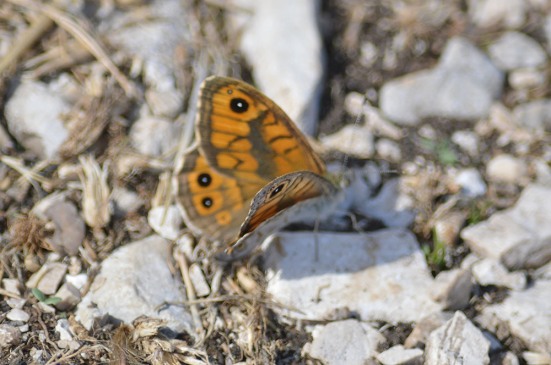
Wall brown

Lasiommata megera ~ Wall Brown ~ mali pjegavac

Hmmm, the field notes say the Wall brown is very alert and difficult to approach for taking photos – well, that’s certainly true! This guy was spotted beside the path on the way up to Sv Nikola, and this is the best photograph I could manage!

A recent (2011-13) study of butterflies on Hvar recorded 49 species, some of which are very rare within Croatia. All in all, 57 species have been recorded on Hvar, giving it 4th place among the islands for butterfly diversity. I have a long way to go to spot all those!

“Happiness is a butterfly, which when pursued, is always just beyond your grasp, but which, if you will sit down quietly, may alight upon you.”
~ Nathaniel Hawthorne

© Marion Podolski 2016

More about Croatia’s butterflies:

Project Noah: Butterflies and Moths of Croatia

Euro Butterflies by Matt Rowlings

Wikipedia list of butterflies and moths in Croatia

Annoted list of Croatian butterflies with vernacular names (PDF file for download)

Contribution to the knowledge of the butterfly fauna on the Adriatic island of Hvar, Croatia

This article has been reproduced with kind permission from Marion's blog Go Hvar, Ramblings about a far island. Visit the blog for all kinds of information about Hvar, from artistic to epicurean!

Nalazite se ovdje: Home Novosti iz prirode Hvar's Butterflies

Novosti: Ekologija.hr

  • ONS data shows rising toll of climate crisis, with officials warning this summer on track to set further records

    Over 40,000 more people died on the hottest days in England between 1988 and 2025 than would be expected, according to data published by the Office for National Statistics on Wednesday.

    The figures do not include this summer, when England has sweltered under a succession of heatwaves and is on track to record its highest ever number of heat-related deaths. The UK Health Security Agency announced on 30 July that an estimated 2,877 people had died in the May and June heatwaves alone. The total is almost double the figure for the whole summer in 2025.

    Continue reading...

  • Civil society groups argue climate crisis means transport sector needs to urgently reduce its carbon emissions

    Dozens of civil society groups have demanded the UK government do more to promote cycling and walking, after this summer’s extreme heat exposed the desperate need to decarbonise transport.

    This summer’s heatwaves and wildfires were “immediate, real-world manifestations of the climate emergency”, the groups said, making reform of transport – responsible for more carbon emissions than any other sector in the UK – an urgent priority.

    Continue reading...

  • Research finds demand has more than doubled since 2000 and 80% of current demand comes from Asia

    A booming demand for concrete has resulted in sand and gravel being extracted from riverbeds faster than nature can replenish it. A study published in Reviews of Geophysics shows that the demand for sand and gravel has more than doubled in the last two decades, with overextraction leading to weaker riverbanks, lower groundwater levels, coastal salt intrusion and poorer water quality.

    In 2024, city-building and infrastructure projects around the world turned 28bn tonnes of sand and gravel into concrete. Researchers reviewed data on sand and gravel extraction going back to 1974 and have shown that since 2000 demand has more than doubled, with more than 80% of current demand coming from Asia, supporting urban development and road-building across China and India in particular. They found much of the material was being extracted from rivers across Asia and Africa. Data on extraction is scarce but where it does exist the researchers showed that extraction often exceeded natural sediment replacement severalfold.

    Continue reading...

  • Even low levels of traffic noise can negate the benefits of listening to natural sounds, researchers say

    Hearing the trill or whistle of a bird while going about daily life is well known to boost people’s mood. But a new study suggests the psychological benefits of hearing birdsong are being threatened by traffic noise.

    Researchers found that even low levels of traffic noise negatively affected the benefits to wellbeing that could otherwise be derived from listening to natural sounds.

    Continue reading...

  • Protests and petitions planned amid growing concerns over impact of climate crisis on numbers of Alpine rodent

    Animal rights campaigners are gearing up for protests and petitions aimed at persuading the French government to ban the hunting of Alpine marmots.

    Open season on the rodents, members of the squirrel and groundhog family, begins in September, a few weeks before they go into a long winter hibernation.

    Continue reading...

  • Asturias, Spain: Wild Finca is thrilling in its ecological abundance, and was created in just eight years despite countless obstacles

    On a rocky 13-hectare pocket in the foothills of the Picos de Europa, Luke Massey and Katie Stacey are raising children, dogs, cattle, chicken, ducks, geese and eyebrows. In their eight years here, the farm they call Wild Finca has become a mass of scrub, with scattered large trees and dozens of clearings that Luke calls fields, but which look more like tiny irregular glades, riddled with trails and hemmed all around by the blackthorn, gorse and bramble that has sprung up around the tumbled remains of drystone walls.

    If Wild Finca is a forever home to the Massey-Staceys, it is a whole world to nature. Witness the butterflies and wasp spiders, the snakes, lizards, hedgehogs and sparrows, and the thousand-piece cricket orchestra that performs each evening as the glow-worms light up. It offers denning and roosting sites for foxes, pine martens, badgers and 17 species of bat, feeding opportunities for roe deer and wild boar, several species of eagle and vulture, and a pit stop for others such as the nightingale I heard singing in early morning mist.

    Continue reading...

  • Exclusive: Economic harm of CO2 pollution from Rosebank and Jackdaw forecast to far outweigh any boost to UK

    The climate damage caused by developing the Rosebank and Jackdaw oil and gas fields under consideration by the UK government would destroy their economic benefits many times over, according to an analysis.

    It estimates the economic damage caused by the carbon pollution from the oil and gas produced would be between £119bn and £336bn in the coming decades, compared with the £28.7bn in value to the UK estimated by Adura, the fossil fuel company promoting the new fields.

    Continue reading...

  • Jack Klein takes heat readings, gives fans to overheated passengers and lugs big jugs of water into the stations

    On a recent August day in the subterranean furnace of New York City’s subway, one bearded, curly haired man was studying his phone for different reasons than the other wilting passengers – to track the soaring temperatures and ponder how underground train stations can cool down in an era of climate crisis.

    Jack Klein, a 31-year-old construction site manager, has in the past two years taken it upon himself to become a sort of guerrilla subway heat operative, sticking teardrop-shaped thermometers to steel beams in seven of the hottest Manhattan stations and posting social media videos of the hades-like summer temperatures that commuters have to endure.

    Continue reading...

  • Robert Corrigan has been dealing with the ‘smart’ rodents all his life – and believes there are better solutions to deal with the growing infestation in the world’s cities

    “The rodents have paid for every single bill I’ve ever had – every mortgage, every car payment, every pint of Guinness,” says Dr Robert Corrigan. “It’s been a great ride and I’m still at it.”

    New York-based Corrigan is one of the most respected voices in the world of rodentology. Now in his 70s, he has devoted his entire adult life to studying rats and our relationship with them.

    Continue reading...

  • There are countless initiatives around the world that can inspire people and spur them into action. Amid the devastation of the climate crisis, our journalists strive to highlight these stories of hope

    The news is very often about the bad things (especially if you’re on the Guardian’s environment desk). Wildfires, floods, tipping points, billionaires making huge profits and buying themselves island refuges for the apocalypse … And yet, ticking along beside that is the steady pulse of what the rest of humanity is doing in response to the climate crisis. From housing developments with no cars to buildings made out of hemp, all over the planet people are ploughing ahead and changing their neighbourhoods and cities and the world.

    But as news stories typically need to be about new developments or things people didn’t previously know about, it can be hard to cover all those brilliant initiatives being undertaken in the background – no matter how cheering they are. Which is why, back in 2023, we decided to ignore the usual rules about what constitutes “news” and start writing about them anyway. Readers, we knew, would like to hear about them.

    Climate campaign 2026: help us reach 30,000 acts of support

    Continue reading...

Novosti: Cybermed.hr

Novosti: Biologija.com