Hvar's Wild Flowers in the Late Summer

Marion Podolski, author of the exquisite blog Go Hvar, continues her illustrated seasonal researches into Hvar's abundant wild flowers.

Bright roadside field marigold, Jelsa October 2016. Bright roadside field marigold, Jelsa October 2016. Photo: Vivian Grisogono

Following on from our Guide to Hvar’s Wildflowers – Spring Edition, I’ve been out and about looking for what’s in bloom at the end of summer. These are mostly in the high country around the peak of Sv Nikola and on the Vorh plateau, although some are down around sea-level, even right on the beach in some cases.

Heather with black pine on Hvar's highest peak. Photo Marion Podolski

I have to say I was encouraged to find so many wildflowers in September, after what has been a scorching summer. My aim in writing the blog is to identify each one, and tag the photos with an official name in Latin, English and Croatian. With my previously somewhat inexpert pictures in mind, this time I was careful to include more of the plant (leaves, seedpods, etc) in my reference photos. And let’s hope the upcoming new series of that wonderful Croatian TV series  Lovac na bilje, (The Plant Hunter) includes  a trip to the Dalmatian coast and islands, as that could really help me identify the plants here!

Flowers on the beach on Sv.Klement. Photo Marion Podolski

Here’s the reference table of late-summer flowers. Usual disclaimer applies: while I have a reasonable confidence in most of the names, some are tentative especially when very similar suspects exist! I’d welcome any feedback from those with a rather better grounding in botany! Click on the images for a bigger picture, and links take you to wikipedia or plantea to find out more.
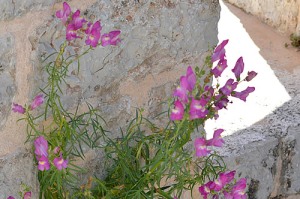
Antirrhinum majus

Antirrhinum majus
Snapdragon
Zijevalica
..........
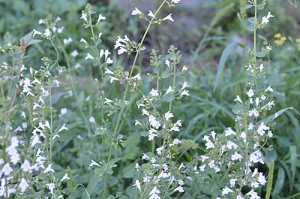
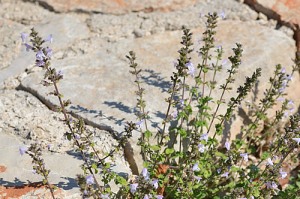
Calamintha napeta

Calamintha napeta
Lesser calamint
Velecvjetna gorska metvica
Mint family but could be wild basil?
..........
..........

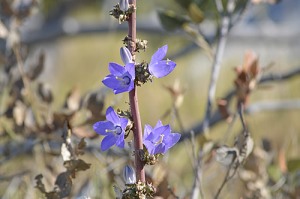
Campanula Pyramidalis

Campanula pyramidalis
Chimney bellflower
Piramidalni zvončić
 ..........

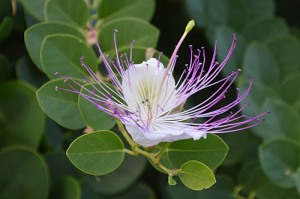
Capparis spinosa

 ..........

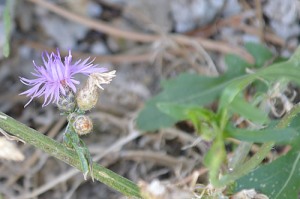
Centaurea glaberrima Tausch

Centaurea glaberrima Tausch or Centaurea jacea
Bare knapweed
Livadna zečina
Not sure exactly which variant of Centaurea this is. Reference pictures differ!
 ..........

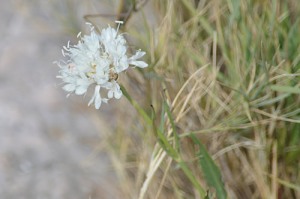
Cephalaria leucantha

Flower head is actually a round ball, hence the Croatian name of White head!
 ..........

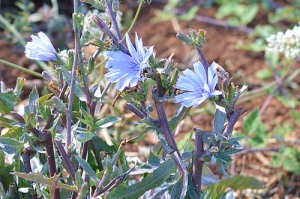
Cichorium intybus

Cichorium intybus
Chicory
Cikorija
 ..........

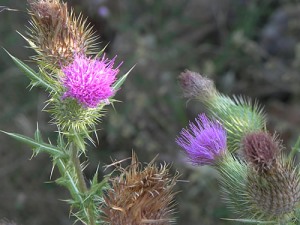
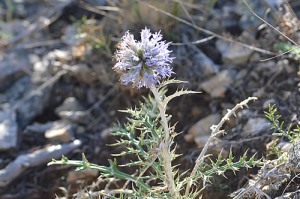
Cirsium vulgare

 ..........

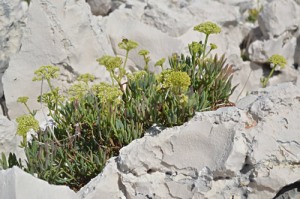
Crithmum maritima

This photo taken on a Sv Klement beach. A similar plant is Salicornia, which turns red as it ages. Both samphire and salicornia are used in cooking.
 ..........

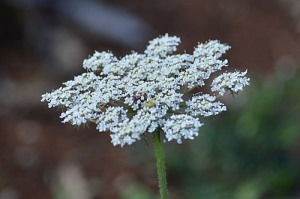
Daucus carota

Daucus carota
Wild carrot
Divlja mrkva
 ..........
 ..........

Dittrichia viscosa

Dittrichia viscosa
Woody or sticky fleabane
Ljepljini oman / brušćinac / bušina
 ..........

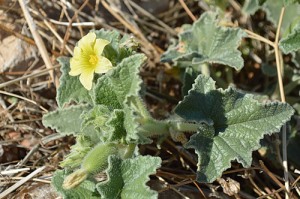
Ecballium

Ecballium
Squirting cucumber
Divlji krastavac
 ..........

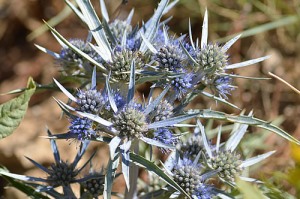
Echinops ritro

Echinops ritro
Southern globethistle
Globus čičak
 ..........
 ..........

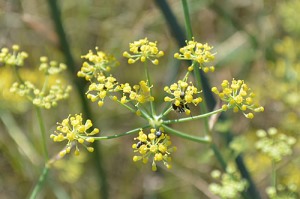
Foeniculum vulgare

 ..........

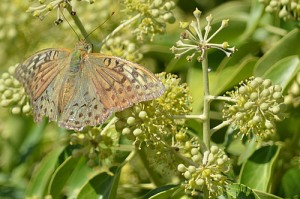
Hedera helix poetarum nyman

This version of ivy is native to southern Europe, and the flowers are high in nectar. Which is why this mound of ivy on Vorh was absolutely swarming with happy bees and butterflies! This one is a Cardinal.
 ..........

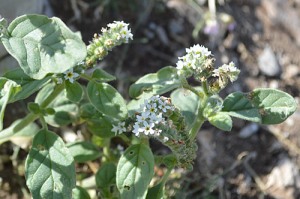
Heliotropium europaeum

 ..........

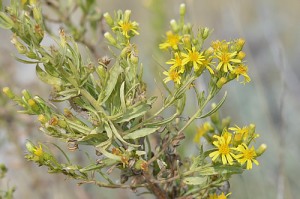
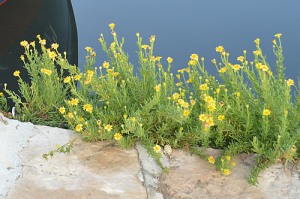
Inula crithmoides

Inula Crithmoides / Limbarda crithmoides
Golden Samphire
Primorski oman
Compare to samphire/motar above
..........

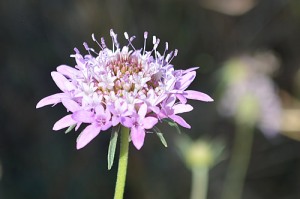
Knautia arvenensis

 ..........

Limonium cancelatum

Limonium cancelatum
Lattice sea-lavender
Rešetkasta mrižica or Rešetkasta travulja
This tiny variant of sea-lavender appears to be local to Croatia. Seen on Sv Klement beach.
 ..........

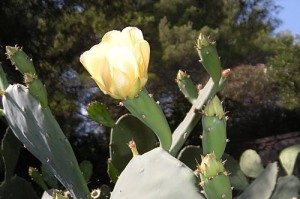
Opuntia ficus-indica

Opuntia ficus-indica
Opuntia / prickly pear
Opuncija
An exotic import from Mexico that grows well here!
 ..........

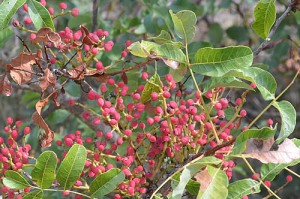
Pistacia terebinthus

The berries on this bush are really pretty, but the Croatian name is “Smelly“
 ..........

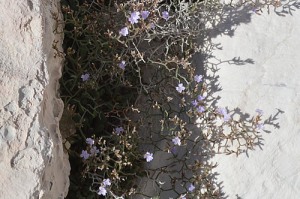
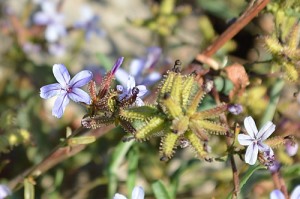
Plumbago europaea

Plumbago europaea
Common leadwort
Vranjemil?
Few references  even mention this European version of plumbago! Flower looks very similar to the Scilla (below), but this has 5 petals, not 6 and the clusters are different.
 ..........

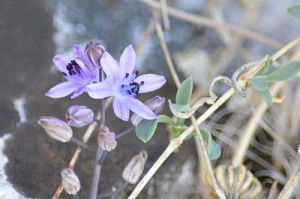
Scilla autumnalis

Scilla autumnalis or Prospero autumnale
Autumn squill
Jesenji procjepak
In this case, the leaves are misleading as they belong to another plant!
 ..........

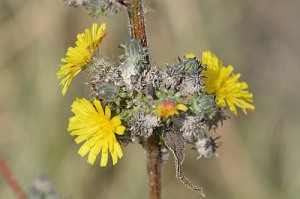
Sonchus asper

Sonchus asper
Perennial sow-thistle
Modrozeleni ostak or Kostriš
 ..........

“Weeds are flowers too, once you get to know them” ~ A.A. Milne

© Marion Podolski 2016

 This article has been reproduced with kind permission from Marion's blog Go Hvar, Ramblings about a far island. Visit the blog for all kinds of information about Hvar, from artistic to epicurean!


Nalazite se ovdje: Home Novosti iz prirode Hvar's Wild Flowers in the Late Summer

Novosti: Ekologija.hr

  • Explosives used to move a large rock and let more water flow to cool nuclear power plant

    More must be done ⁠to strengthen the European Union’s borders at critical points, ⁠European Commission president ⁠Ursula ​von der Leyen told Spanish prime minister Pedro Sánchez ⁠in a letter.

    In the letter, first reported by Reuters and a number of Spanish media, von der Leyen was quoted as congratulating Spain for swiftly handling the incident and “successfully preventing” the onward migration to mainland Spain and the EU.

    Continue reading...

  • This detritivore – known by a range of colourful names – tidies up our world and can withstand toxic pollution

    Chucky pig. Slater. Monkey pea. Roly-poly. Boat-builder. Butchy boy. Cheeselog. Hobbling Andrew. Wood pig. If there were a prize for the range and joyfulness of a creature’s English-language names, the humble woodlouse would undoubtedly triumph over its million-plus invertebrate rivals.

    Over centuries of easy cohabitation with humans, it has acquired more than 300 regional names in Britain alone, and many more in other languages (such as Gwrach y Coed, “witch of the wood”, in Welsh).

    Continue reading...

  • Farmers battle to salvage what they can of their crops as heatwave set to continue

    Britain could face shortages of certain foods after punishing drought in parts of England, the National Farmers’ Union (NFU) has warned as a heatwave was forecast to continue into next week.

    The UK’s Health Security Agency (UKHSA) has issued heat health alerts for eight regions of England, with temperatures set to rise above 30C in parts of the country. UKHSA said rising temperatures may increase health risks, particularly for vulnerable groups.

    Continue reading...

  • Volunteers painstakingly gather plastic pellets washing up on beaches after ship collision on 19 July

    ‘You’ve got a local community that really cares about the coastline,” said Alice Laverty, reflecting on the huge army of volunteers who had taken to crisis-hit beaches in north-east England with passion and only the most basic tools. “They’ve all got a dustpan, a brush, a bucket, a kitchen sieve.”

    On beaches from Cambois in Northumberland to Seaburn on Wearside, up to 2,000 dedicated volunteers have been painstakingly sifting through sand to find tiny, lentil-sized pellets of plastic.

    Continue reading...

  • Soaring temperatures continue to sweep parts of Europe, while Okinawa faces powerful winds and storm surges

    Unbearable, record-breaking heat has dominated the summer of 2026 across much of Europe. New records were set in central Europe last week, with Wieselburg in Austria registering a new July peak of 40.3C (104.5F). This is particularly significant as it is just 0.2C behind the all-time high, set in the August of 2003.

    However, not all of the northern hemisphere has experienced extreme heat and aridity. Vancouver recorded its wettest July since 2016 and the third wettest since 2008, with 33.6mm of rain. While that total may not appear exceptional, it is only a touch above the 1991-2020 climate average, highlighting how unusually dry July has been in the Canadian city over the past decade.

    Continue reading...

  • Garrigill, Cumbria: The abandoned Tynebottom mine is alive with vivid orange, raspberry-ripple pink and sulphurous yellow. But it’s the cave pearls that captivate me most

    At first I can’t believe that there’s a way in, the entrance is so hidden by downy willow, ferns and field rush. Just a trickle of rusty water hints at the opening to an abandoned mine. That we have to push through scrub to enter the underground world only adds to the excitement.

    A long adit stretches before us, lit by our helmet torches, its arched stonework streaked and stained by minerals. We marvel at the precision and detail of the masonry, breathe in smells of damp earth and wood. Led by two miners from nearby Nenthead mines, we’re a small group of potters and artists working towards an exhibition inspired by lead mining in the North Pennines.

    Continue reading...

  • Council leaders say crumbling infrastructure and lack of water are jeopardising government’s plans for new homes

    The government’s housebuilding agenda is hitting the stark reality of a lack of water and crumbling infrastructure across the east and south-east of England.

    Half the country was declared to be in serious drought this week, for the second consecutive year, with the Environment Agency warning of dire consequences for the economy, environment and wildlife.

    Continue reading...

  • After another massacre of smallholders – who are subjected to violence from palm oil firms and drug traffickers – the country’s new Trump-backed government has criminalised community leaders

    Sitting on the back of the motorcycle, 15-year-old Orlean* heard gunshots. A moment later, the bike crashed. His uncle and two cousins fell to the ground dead. Orlean fled into the dense green forest of the palm oil farm and rushed along the dirt road until he was home.

    He survived a massacre, one of only three who did.

    Continue reading...

  • New Zealand sailing team combine racing with campaigning for environmental and social impact

    “Sailing on the Solent was awesome, but our racing … not quite perfect,” says Blair Tuke, co-chief executive of the Black Foils, New Zealand’s SailGP team, after finishing fifth at last month’s Great Britain Sail Grand Prix. It was only the team’s second competitive outing of the season after the boat had to be “pretty much rebuilt” following a big crash in Auckland in February, which forced them to miss four races.

    But the team’s work off the water hasn’t stopped in the boatyard. Before the race in Portsmouth, which coincided with the beginning of National Marine Week in the UK, the Black Foils were awarded the Better Planet award in SailGP’s Impact League that rewards teams for environmental and social impact alongside racing.

    Continue reading...

  • Experts say new power to bypass conservation and planning regulations are incredibly broad and could let the state effectively fast-track any project it wants

    Matt Wood gives Neville a pat behind his ear – as if the one-tonne Droughtmaster bull were an oversized labrador puppy – while his wife, Caitlin, watches hundreds of pasture-fed hens scratch beneath old macadamia trees her dad planted.

    Their talk is of building their regenerative agricultural operation amid the rainforests at the top of Springbrook mountain: adding goats to control fireweed and maremma to protect their chooks from wedge-tailed eagles and letting wild trees grow.

    Continue reading...

Novosti: Cybermed.hr

Novosti: Biologija.com