Hvar's Butterflies

Marion Podolski casts her expert artistic eye over Hvar's butterflies.

Hvar butterfly at work, July 2016 Hvar butterfly at work, July 2016 Vivian Grisogono

Butterflies always seem so fragile, so transient. So it came as quite the surprise when I read that (a) there are butterfly fossils dating back around 56 million years, and (b) the Painted Lady appears to hold the record for the longest return migration, from Africa to the Arctic circle and back!
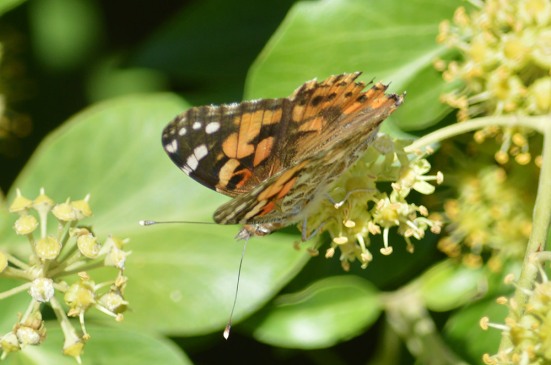
Painted lady

Vanessa cardui ~ Painted lady ~ Stričkovac

This photograph was taken at Vorh on Hvar, altitude around 500 metres. European ivy is known for having flowers high in nectar, and was swarming with butterflies and bees in September. The Painted lady migrates from North Africa and the Mediterranean northwards in the springtime, and southwards in the autumn. The 9,000 mile round trip between tropical Africa and the Arctic circle may take as many as 6 generations! Was this butterfly on a refuelling stop for its Autumn migration?

This summer I’ve been more aware of butterflies on Hvar, possibly due to my recent interest in wildflowers. It’s a good sign, as flowers and butterflies mean a healthy ecosystem. Though sometimes they were nowhere near any flowers!
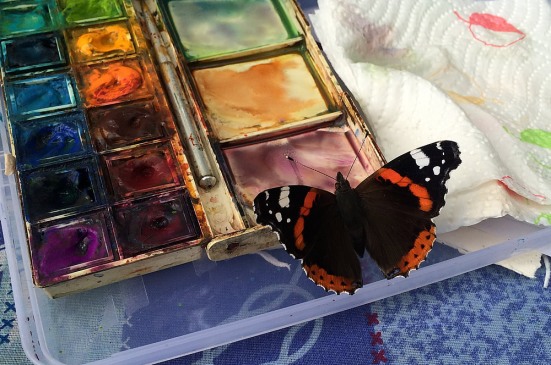
Red admiral

Vanessa atalanta ~ Red Admiral ~ Ljepokrili admiral

As I was sitting on the Soline beach near Vrboska, painting with my art group, this visitor was very interested in my paintbox! Luckily I had my phone to hand, and managed to capture the moment! And as I didn’t really feel that paints were proper nourishment, being toxic and all, I closed up the box, so it decided to try some wine instead!
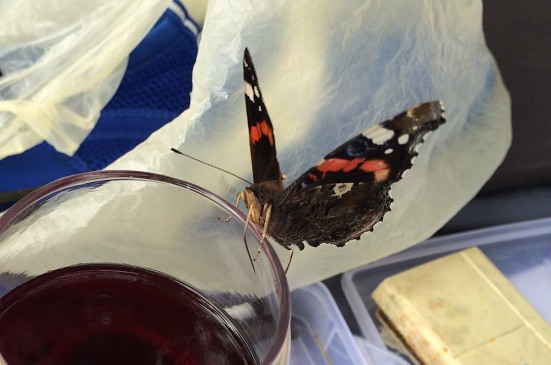
Red admiral likes a glass of wine

My Red admiral likes a glass of wine!

While some (adult) butterflies live only for a few days, other species survive for almost a full year. Those living longer can feed on nectar from flowers, and they are in fact important pollinators for some kinds of plants. Although they can’t carry as much pollen as bees, they are able to take it over longer distances. They’ll also sip water (and wine!), are sometimes  attracted to dung, rotting fruit, or the salt in human sweat for other essential minerals and nutrients. Their “taste” receptors are apparently located on their feet, so they can determine whether a leaf is suitable for laying eggs on (ie the caterpillar kids can eat it!)
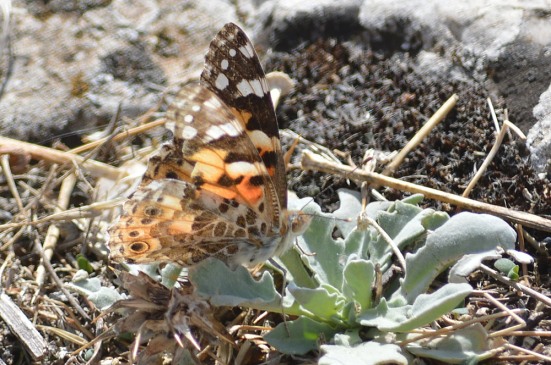
Red admiral underside

Red admiral underside

I spotted this Red admiral near the peak of Sv Nikola, up in the high country (628 metres). Good view of the underside of the wing. Red admirals also migrate, spending summer in northern Europe, and winter near the Mediterranean.

In Croatian, a butterfly is called a leptir, for once easy to remember as it’s clearly related to lepidoptera (from the ancient Greek  lepís=scale + pterón=wing). It’s less certain why the English saw any association with butter, though the name has been around for some time in old Dutch and German. Were there only yellow butterflies in northern Europe, I wonder?
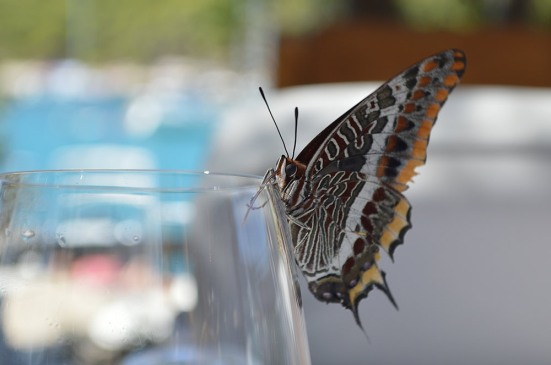
Two-tailed pasha also going for my wine

Charaxes jasius ~ Two-Tailed Pasha ~ vještica

Another butterfly that was keen to share our wine was this Two-tailed Pasha with exceptional taste at restaurant Laganini on Palmižana! It did, in fact, take a dive headfirst into my glass and had to be rescued at the expense of the wine!
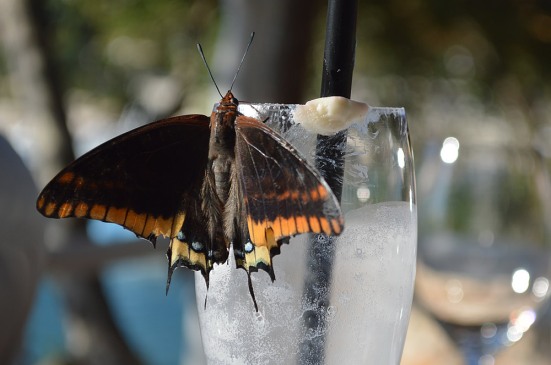
Two-tailed pasha

Two-Tailed Pasha enjoying some lemon sorbet

A fine butterfly, and a great poser with his proboscis stuck into a drop of lemon sorbet (with vodka and prosecco) for a good long drink! Two-tailed pashas produce two generations in a season, flying May/June and August/October. Clearly, they also like a drink!
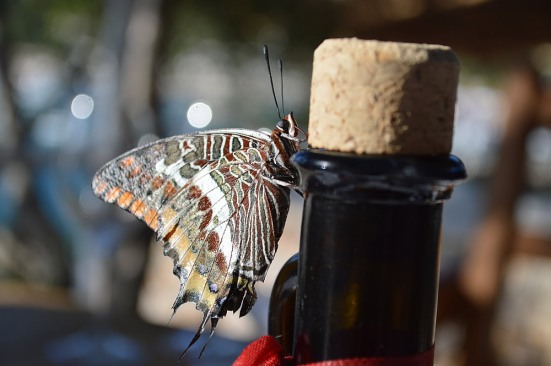
Two-tailed pasha underside

Two-tailed pasha underside and clear view of head

The beautiful colour of butterfly wings is due to the scales. While the dark blacks and browns are melanin pigments, and yellows come from uric acid and flavones, the other bright blues, greens, reds and iridescence are all caused by the structure of the scales and hairs.
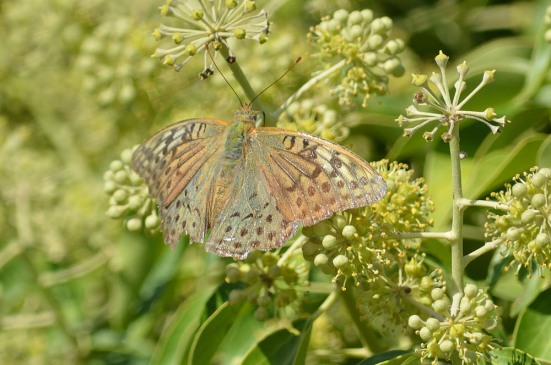
Cardinal

Argynnis pandora ~ Cardinal ~ Pandorin šarenac

Meanwhile, back at the popular ivy flowers, was this lovely Cardinal which is a fairly common butterfly around southern Europe from April to September. Sadly the photograph doesn’t quite do justice to the shimmer of that pale green colour. Very pretty in real life!
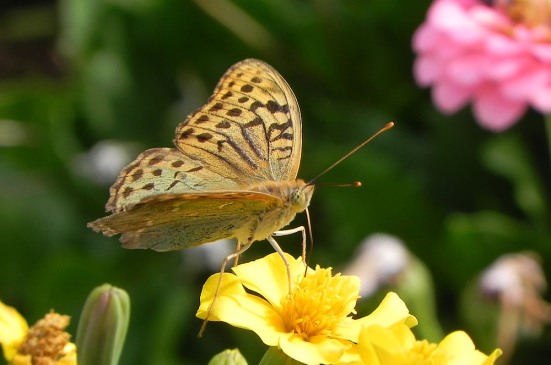
Cardinal in Stari Grad

Cardinal in Stari Grad

The second Cardinal was spotted in a garden in Stari Grad. Good view of the antennae, and the proboscis stuck into the flower. It looks to have only 4 legs, but that’s apparently normal for some types of butterflies, the front two legs are much reduced.
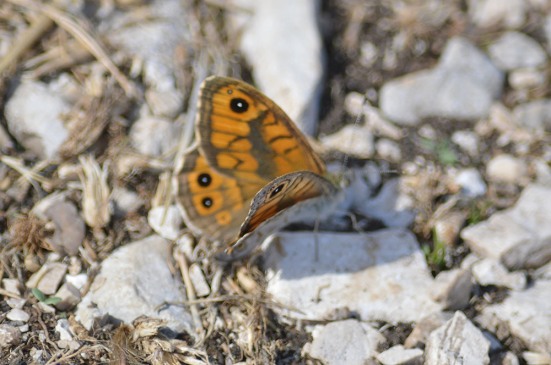
Wall brown

Lasiommata megera ~ Wall Brown ~ mali pjegavac

Hmmm, the field notes say the Wall brown is very alert and difficult to approach for taking photos – well, that’s certainly true! This guy was spotted beside the path on the way up to Sv Nikola, and this is the best photograph I could manage!

A recent (2011-13) study of butterflies on Hvar recorded 49 species, some of which are very rare within Croatia. All in all, 57 species have been recorded on Hvar, giving it 4th place among the islands for butterfly diversity. I have a long way to go to spot all those!

“Happiness is a butterfly, which when pursued, is always just beyond your grasp, but which, if you will sit down quietly, may alight upon you.”
~ Nathaniel Hawthorne

© Marion Podolski 2016

More about Croatia’s butterflies:

Project Noah: Butterflies and Moths of Croatia

Euro Butterflies by Matt Rowlings

Wikipedia list of butterflies and moths in Croatia

Annoted list of Croatian butterflies with vernacular names (PDF file for download)

Contribution to the knowledge of the butterfly fauna on the Adriatic island of Hvar, Croatia

This article has been reproduced with kind permission from Marion's blog Go Hvar, Ramblings about a far island. Visit the blog for all kinds of information about Hvar, from artistic to epicurean!

You are here: Home Nature Watch Hvar's Butterflies

Eco Environment News feeds

  • Study reveals that pesticide poisoning kills 11,000 people each year, with India accounting for nearly 60% of fatalities

    Almost half of the world’s farmers are poisoned by pesticides every single year, a study has found.

    Using publicly available data from 2006-2023, the study, which was commissioned by Pesticide Action Network, found there to be an estimated 402-433m cases of unintentional acute pesticide poisoning of farmers and farm workers every year.

    Continue reading...

  • Campaigners say pheasants and partridges reared ‘on industrial scale’ do not have same protections as chickens

    The government is considering a crackdown on pheasant shooting in England as part of a consultation on strict new animal welfare laws that would affect shoot organisers.

    Ministers are already considering plans for the issuing of licences for those who run game bird shoots. The proposals mean anybody associated with wildlife crime, such as the poisoning or shooting of birds of prey, would be banned from hosting shooting events.

    Continue reading...

  • Andy Burnham has announced a crackdown, but doubts remain over authorities’ ability to take on organised crime

    “There were parents dropping their children off and then heaving from the smell,” says Liz Thompson, 45, who runs Blessings Nursery in Bradford, West Yorkshire.

    During the recent heatwaves, the smell from an illegal waste dump on Midland Road, just metres from the nursery, became so unbearable that staff had to keep the doors and windows shut and the children couldn’t play outside.

    Continue reading...

  • Meteorologists say mean average temperature of 16.5C was made 130 times more likely by climate crisis

    This year’s summer was the UK’s hottest on record, according to provisional data, and the Met Office said the season’s mean temperature was made 130 times more likely by the climate crisis.

    Record-breaking and back-to-back heatwaves have scorched much of Europe. In England, temperatures peaked at 38.1C (100.1F) at Kew Gardens in London on 13 August, and June had already been confirmed as the country’s hottest since records began in 1884. Scientists have said these heatwaves are only possible because of the climate crisis driven by burning fossil fuels.

    Continue reading...

  • As families await news of missing loved ones, the disaster is a stark reminder of how the climate crisis is creating a fast-growing threat. Plus, the town considered India’s ‘Jurassic Park’

    Don’t get This is India delivered to your inbox? Sign up here

    It has been hard not to despair while watching the ruinous floods swallow parts of Nepal, and harder, still knowing that the agony compounds each passing day for dozens of Indian families whose members remain unaccounted for.

    Social media is awash with desperate pleas, photos and details of the young and old, men and women, from Mumbai to Kolkata, posted by families searching for traces of life. The disaster unfolded when a melting glacier slammed into the valley below, unleashing a deadly cascade of rock and ice down the Bhote Kashi River, which flows from Tibet into Nepal.

    Continue reading...

  • Head of tree collections at Kew ‘very worried about this autumn’ as hot, dry summer has caused brittleness

    High winds associated with El Niño could cause widespread mortality among tree species already weakened by a prolonged period of extreme heat and drought, experts have warned.

    This summer much of Europe has been scorched by a series of record-breaking climate crisis-induced heatwaves. The impact is notable across much of England’s countryside, where once green land has turned brown, and many trees are undergoing “early autumn” – wilting and losing their leaves early – to cope with extreme heat.

    Continue reading...

  • Savings grow as energy prices in Great Britain rise and cost of panel installation falls, analysis finds

    Households in Great Britain’s cloudiest regions could still save more than £400 a year on their energy bills by installing rooftop solar panels, research has found.

    Rising wholesale energy prices mean the potential savings from a home solar panel system have climbed in recent years, as the cost of installation has continued to fall, leading to increased demand.

    Continue reading...

  • Climate experts warn US Kalshi and Polymarket users are ‘gamifying disasters’ as they bet on events like heatwaves and daily temperatures

    Online prediction markets, saturated by money staked on sport, crypto and politics, have now set their sights on a promising new area of growth: betting on the future livability of the planet itself.

    The rise of gamified predictions on the unfolding climate crisis, and shorter-term weather forecasts, has been underscored by a new deal that allows Kalshi, a leading online financial exchange, to access data from the Weather Company, owner of the Weather Channel, to verify weather-related betting outcomes.

    Continue reading...

  • Arthur Downing, author of Power and the People: A History of British Energy, says all-encompassing rapid transition will need a mutualised system

    Have you ever wondered why it is that most houses in the UK are reliant on gas boilers? Not what’s stopping more people from replacing them with heat pumps, but instead why and how the gas boiler became so ubiquitous in the first place?

    Arthur Downing, the author of the new book Power and the People: A History of British Energy, can tell you exactly why. “We only have boilers in our houses because of a state-owned enterprise that went into everybody’s home and installed natural gas-suitable appliances at no direct cost,” he says. The nationalised gas industry of the 1940s to the 1980s, which oversaw this huge project, was for three decades one of the “most dynamic, innovative, efficient industries in Britain”, Downing says. Yet few of us would use these terms to describe it as such now.

    Continue reading...

  • Northern landscapes could soon look different, as wildfires and storms disturb boreal forests

    A warmer world is making high latitude forests more deciduous and less evergreen, research shows. Global heating has increased the likelihood of extreme events such as wildfires and storms and this warmer and less stable environment is favouring deciduous trees over evergreens.

    Boreal forest stretches for miles and miles across high northern latitudes, covering huge swathes of Canada, Russia, Alaska and Scandinavia. It makes up nearly a third of global forest area and is mainly made up of evergreen trees such as spruce and fir. But this landscape could change.

    Continue reading...

Eco Health News feeds

Eco Nature News feeds