Hvar's Butterflies

Marion Podolski casts her expert artistic eye over Hvar's butterflies.

Hvar butterfly at work, July 2016 Hvar butterfly at work, July 2016 Vivian Grisogono

Butterflies always seem so fragile, so transient. So it came as quite the surprise when I read that (a) there are butterfly fossils dating back around 56 million years, and (b) the Painted Lady appears to hold the record for the longest return migration, from Africa to the Arctic circle and back!
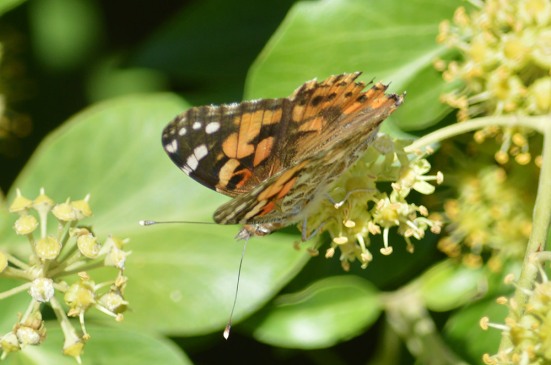
Painted lady

Vanessa cardui ~ Painted lady ~ Stričkovac

This photograph was taken at Vorh on Hvar, altitude around 500 metres. European ivy is known for having flowers high in nectar, and was swarming with butterflies and bees in September. The Painted lady migrates from North Africa and the Mediterranean northwards in the springtime, and southwards in the autumn. The 9,000 mile round trip between tropical Africa and the Arctic circle may take as many as 6 generations! Was this butterfly on a refuelling stop for its Autumn migration?

This summer I’ve been more aware of butterflies on Hvar, possibly due to my recent interest in wildflowers. It’s a good sign, as flowers and butterflies mean a healthy ecosystem. Though sometimes they were nowhere near any flowers!
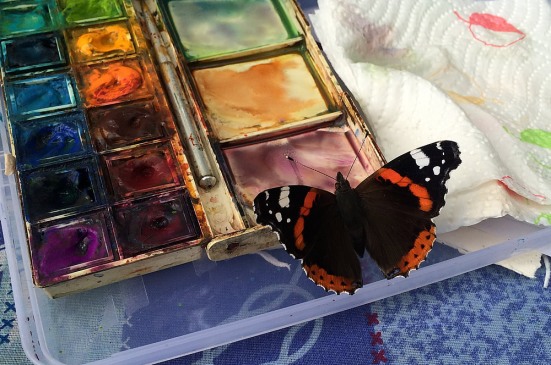
Red admiral

Vanessa atalanta ~ Red Admiral ~ Ljepokrili admiral

As I was sitting on the Soline beach near Vrboska, painting with my art group, this visitor was very interested in my paintbox! Luckily I had my phone to hand, and managed to capture the moment! And as I didn’t really feel that paints were proper nourishment, being toxic and all, I closed up the box, so it decided to try some wine instead!
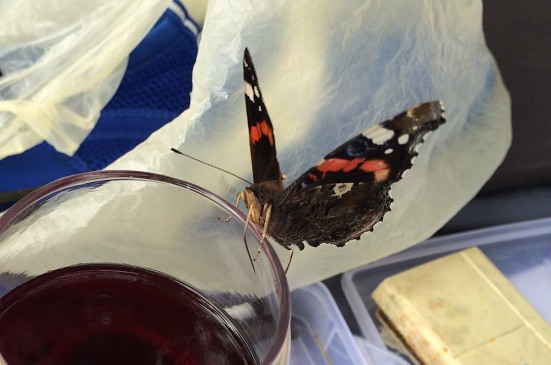
Red admiral likes a glass of wine

My Red admiral likes a glass of wine!

While some (adult) butterflies live only for a few days, other species survive for almost a full year. Those living longer can feed on nectar from flowers, and they are in fact important pollinators for some kinds of plants. Although they can’t carry as much pollen as bees, they are able to take it over longer distances. They’ll also sip water (and wine!), are sometimes  attracted to dung, rotting fruit, or the salt in human sweat for other essential minerals and nutrients. Their “taste” receptors are apparently located on their feet, so they can determine whether a leaf is suitable for laying eggs on (ie the caterpillar kids can eat it!)
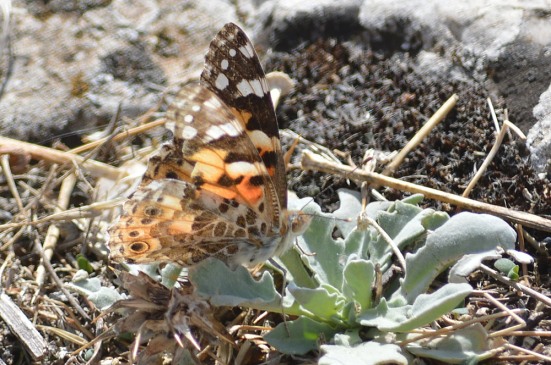
Red admiral underside

Red admiral underside

I spotted this Red admiral near the peak of Sv Nikola, up in the high country (628 metres). Good view of the underside of the wing. Red admirals also migrate, spending summer in northern Europe, and winter near the Mediterranean.

In Croatian, a butterfly is called a leptir, for once easy to remember as it’s clearly related to lepidoptera (from the ancient Greek  lepís=scale + pterón=wing). It’s less certain why the English saw any association with butter, though the name has been around for some time in old Dutch and German. Were there only yellow butterflies in northern Europe, I wonder?
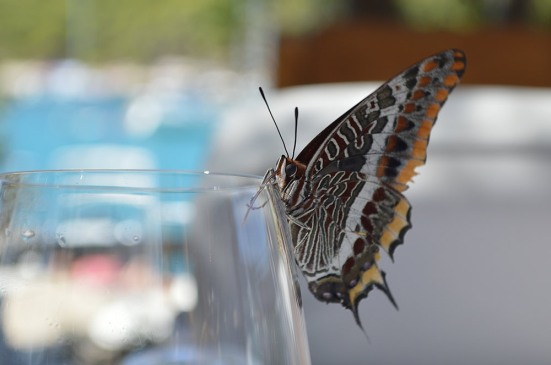
Two-tailed pasha also going for my wine

Charaxes jasius ~ Two-Tailed Pasha ~ vještica

Another butterfly that was keen to share our wine was this Two-tailed Pasha with exceptional taste at restaurant Laganini on Palmižana! It did, in fact, take a dive headfirst into my glass and had to be rescued at the expense of the wine!
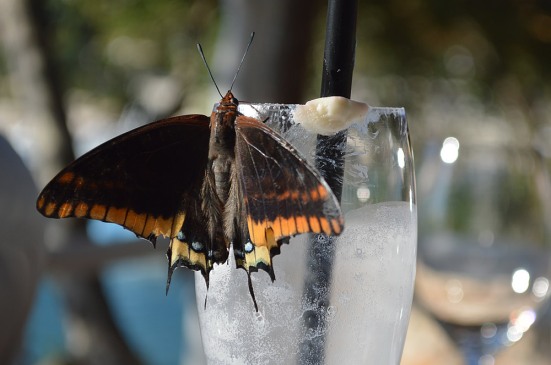
Two-tailed pasha

Two-Tailed Pasha enjoying some lemon sorbet

A fine butterfly, and a great poser with his proboscis stuck into a drop of lemon sorbet (with vodka and prosecco) for a good long drink! Two-tailed pashas produce two generations in a season, flying May/June and August/October. Clearly, they also like a drink!
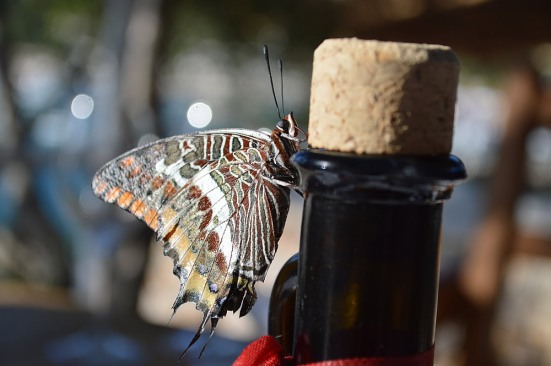
Two-tailed pasha underside

Two-tailed pasha underside and clear view of head

The beautiful colour of butterfly wings is due to the scales. While the dark blacks and browns are melanin pigments, and yellows come from uric acid and flavones, the other bright blues, greens, reds and iridescence are all caused by the structure of the scales and hairs.
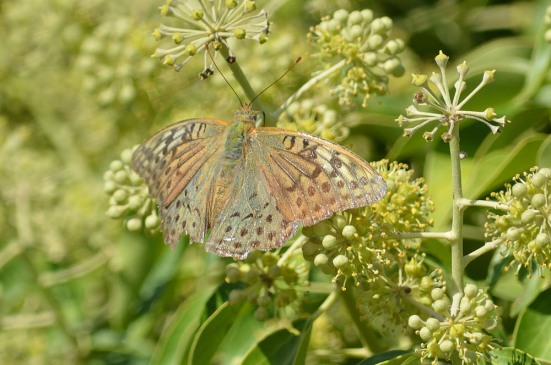
Cardinal

Argynnis pandora ~ Cardinal ~ Pandorin šarenac

Meanwhile, back at the popular ivy flowers, was this lovely Cardinal which is a fairly common butterfly around southern Europe from April to September. Sadly the photograph doesn’t quite do justice to the shimmer of that pale green colour. Very pretty in real life!
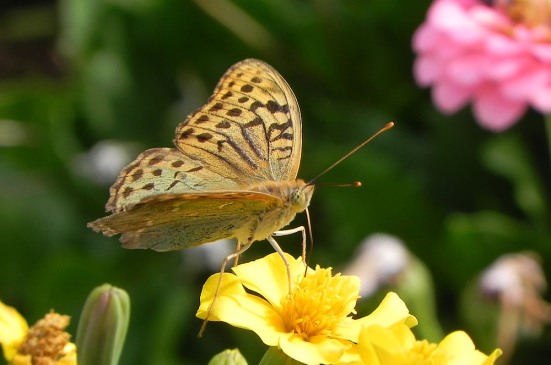
Cardinal in Stari Grad

Cardinal in Stari Grad

The second Cardinal was spotted in a garden in Stari Grad. Good view of the antennae, and the proboscis stuck into the flower. It looks to have only 4 legs, but that’s apparently normal for some types of butterflies, the front two legs are much reduced.
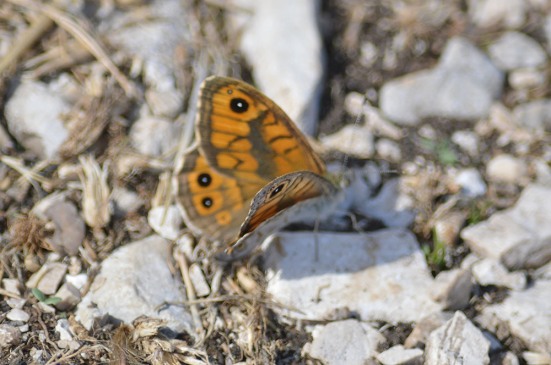
Wall brown

Lasiommata megera ~ Wall Brown ~ mali pjegavac

Hmmm, the field notes say the Wall brown is very alert and difficult to approach for taking photos – well, that’s certainly true! This guy was spotted beside the path on the way up to Sv Nikola, and this is the best photograph I could manage!

A recent (2011-13) study of butterflies on Hvar recorded 49 species, some of which are very rare within Croatia. All in all, 57 species have been recorded on Hvar, giving it 4th place among the islands for butterfly diversity. I have a long way to go to spot all those!

“Happiness is a butterfly, which when pursued, is always just beyond your grasp, but which, if you will sit down quietly, may alight upon you.”
~ Nathaniel Hawthorne

© Marion Podolski 2016

More about Croatia’s butterflies:

Project Noah: Butterflies and Moths of Croatia

Euro Butterflies by Matt Rowlings

Wikipedia list of butterflies and moths in Croatia

Annoted list of Croatian butterflies with vernacular names (PDF file for download)

Contribution to the knowledge of the butterfly fauna on the Adriatic island of Hvar, Croatia

This article has been reproduced with kind permission from Marion's blog Go Hvar, Ramblings about a far island. Visit the blog for all kinds of information about Hvar, from artistic to epicurean!

You are here: Home Nature Watch Hvar's Butterflies

Eco Environment News feeds

  • Secretive state begins repairs on ageing facilities after being revealed as worst country for leaks of potent greenhouse gas

    Turkmenistan has started plugging the mega-leaks of methane that spew from its ageing oil and gas facilities, the latest UN data shows, in a move hailed as a breakthrough.

    Methane, also called natural or fossil gas, is a potent greenhouse gas. It traps 80 times more heat than carbon dioxide and causes 25% of global heating today. Stopping leaks can be quick and cheap and, because methane breaks down in the atmosphere far quicker than CO2, this has a rapid impact, with some experts calling it the climate “emergency brake”.

    Continue reading...

  • Scientists say system to treat contaminated wastewater offers a model for ensuring food security in a fast-warming climate

    All it took to turn the murky, heavily polluted waters of South Africa’s Stiebeuel River into a resource clean enough for irrigating a community’s vegetable plots was a collection of stones, heat-treated wood and sand.

    Without chemicals and using renewable energy, researchers from the University of Cape Town are cleaning 36,000 litres of water, polluted by sewage, chemicals, and traces of drugs and medication, every day to make it usable for growing food in a fast-expanding informal settlement along the course of the river.

    Continue reading...

  • Organisers say people must revive spiritual relationship with food amid double threat of climate crisis and conflict

    Mending the broken food system under the threat of climate-driven weather extremes will require more than economic fixes and intensive agriculture, according to the organisers of a pioneering summit this week, who say the world must revive its spiritual relationship with food.

    Delegates from more than 60 countries and the UN will gather for the next five days in Paro in the tiny Himalayan nation of Bhutan for the world’s first “conscious food summit”, which will bring together governments and farmers, mindfulness experts and yoga therapists.

    Continue reading...

  • More than 200mm of rain forecast in parts of South Korea, while parts of southern Europe to be 10C above average

    South Korea’s prime minister, Han Seong-sook, met officials to prepare for heavy rain expected this week, with rainfall totals across central and northern parts of the country forecast to exceed 200mm in some areas.

    South Korea was battered by heavy rainfall earlier this month and some areas were particularly hard hit. Over the weekend further thunderstorms pushed into the region and these are expected to cause disruption through Monday. This heavy rain is caused by a series of severe thunderstorms that developed over the Yellow Sea, on the western side of South Korea, and will slowly push eastwards on Monday before easing on Tuesday. These storms have been strengthened by the very warm Yellow Sea, which now has a surface temperature of 29C, 4C above the climatological average.

    Continue reading...

  • Checking for sewage spills has become as normal as checking the weather forecast, say swimmers on East Sussex beaches

    “I’m furious,” says Jo Armstrong, 75, sitting on Brighton beach with her daughter and granddaughter.

    Armstrong lives in Lewes, a town 8 miles from Brighton, and usually goes swimming in nearby Seaford in East Sussex every day. But over the past week the water there has been too polluted to swim. “Brighton beach was the only place that stayed clean,” she says.

    Continue reading...

  • Exclusive: Friends of the Earth finds greatest sewage discharge in Devon, Cornwall, Dorset and Somerset

    South West Water is doing more harm to the environment than any other water company in England, according to new analysis, with more sewage discharged in Devon, Cornwall, Dorset and Somerset than anywhere else.

    Friends of the Earth analysed water companies’ environmental performance in six categories: sewage spills, water quality at bathing sites, pollution incidents or warnings at bathing sites, severity of sewage pollution at bathing sites, the percentage of rivers rated below the standard for good ecological health, and the affordability of bills.

    Continue reading...

  • Each year, the Guardian reaffirms its commitment to the environment – both in our reporting and how we operate as a business. From critical tipping points to war in Iran, this is how the last 12 months have looked

    Today marks the end of the Guardian’s annual climate support campaign. Each year, during the campaign, we remind our audience about the Guardian’s role in covering the threats to our planet and the importance of independent journalism in telling that story. Our climate pledge is a reminder of the environmental values we place at the heart of our reporting and our organisation.

    Since our 2025 climate pledge, the world has experienced extreme levels of heat as well as extreme forms of denial and abdication in the face of the climate crisis. But, across the world, there have also been inspiring efforts to tackle it.

    We will be publishing our annual company emissions data in the autumn, explaining what drives our emissions and where they have risen and fallen.

    We have started the process of estimating our emissions from generative AI usage. We hope to report on this next year.

    We have undertaken our B Corp recertification in line with the new standards introduced by B Lab in 2026. We will find out our result later this year.

    We have participated in advertising industry working groups that published a methodological framework that aims to capture the emissions impact of digital and print advertising.

    We open ourselves up to scrutiny by independent third parties, such as the Science Based Targets initiative (SBTi) and B Corp, so they can assess the robustness of our targets and our internal policies.

    Continue reading...

  • The long-running series in which readers answer other readers’ questions considers a change that might help the environment

    This week’s question: Would equal pay create a better society?

    If all the vehicles on the planet had their tyres pumped up with CO2, would this lock up enough carbon to lower the amount in the air significantly? Would there be other issues, such as the carbon cost of trapping it all into the tyres? Chris Coldwell, Lancaster

    Send new questions to[email protected].

    Continue reading...

  • With millions of club shirts going to waste every season, a radical recycling rethink is needed

    When Joanna Czutkowna buried a Manchester United jersey, a cotton T-shirt and a wool-cotton jumper in her Lancashire farm and dug it up a year later, the video went viral. The T-shirt had disappeared, apart from the seams (sewn with polyester thread), the jumper was 80% gone, but the United shirt remained – grubby but indestructible. (Insert joke here)

    The big reveal was not a surprise, certainly not to Czutkowna, who has worked in textiles and sustainability for 20 years, but it was a reminder: a football jersey is not just for Christmas, or even the next hundred Christmases.

    Continue reading...

  • The movement against datacenters is uniting Americans because they perfectly illustrate how a few individuals hold all the power to control decisions that affect our lives

    Bryce Gustafson has been knocking on doors in Indiana for more than a decade. The lead organizer with Citizens Action Coalition (CAC), a consumer and environmental organization, he usually encounters a mix of reactions when he’s out canvassing; whatever issue he’s talking about, there’s always at least a few people on the other side. But at a recent festival in the rural town of Monrovia, Indiana, he was struck by an unusual spirit of unity.

    He was there about a proposed datacenter, a 550-acre (222-hectare) Google project in this small town of 1,600 people. “I had 50 people I talked to,” Gustafson told me. “Nobody wanted that datacenter in their community. And at least a half a dozen people came up to me to say, ‘Hey, I voted for Trump. What the heck’s he doing, supporting these things?’”

    Continue reading...

Eco Health News feeds

Eco Nature News feeds