Hvar's Butterflies

Marion Podolski casts her expert artistic eye over Hvar's butterflies.

Hvar butterfly at work, July 2016 Hvar butterfly at work, July 2016 Vivian Grisogono

Butterflies always seem so fragile, so transient. So it came as quite the surprise when I read that (a) there are butterfly fossils dating back around 56 million years, and (b) the Painted Lady appears to hold the record for the longest return migration, from Africa to the Arctic circle and back!
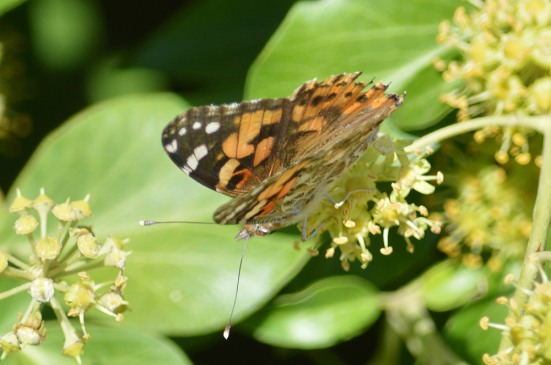
Painted lady

Vanessa cardui ~ Painted lady ~ Stričkovac

This photograph was taken at Vorh on Hvar, altitude around 500 metres. European ivy is known for having flowers high in nectar, and was swarming with butterflies and bees in September. The Painted lady migrates from North Africa and the Mediterranean northwards in the springtime, and southwards in the autumn. The 9,000 mile round trip between tropical Africa and the Arctic circle may take as many as 6 generations! Was this butterfly on a refuelling stop for its Autumn migration?

This summer I’ve been more aware of butterflies on Hvar, possibly due to my recent interest in wildflowers. It’s a good sign, as flowers and butterflies mean a healthy ecosystem. Though sometimes they were nowhere near any flowers!
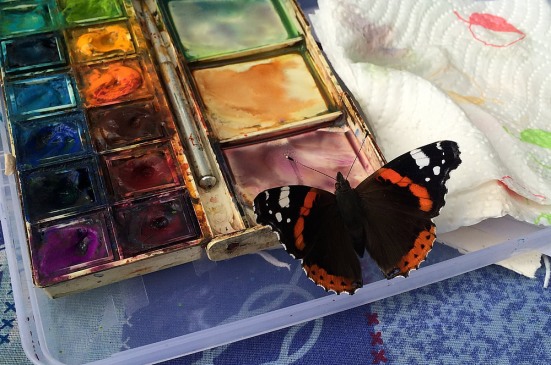
Red admiral

Vanessa atalanta ~ Red Admiral ~ Ljepokrili admiral

As I was sitting on the Soline beach near Vrboska, painting with my art group, this visitor was very interested in my paintbox! Luckily I had my phone to hand, and managed to capture the moment! And as I didn’t really feel that paints were proper nourishment, being toxic and all, I closed up the box, so it decided to try some wine instead!
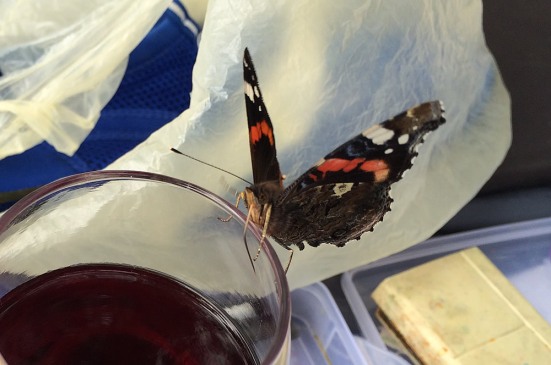
Red admiral likes a glass of wine

My Red admiral likes a glass of wine!

While some (adult) butterflies live only for a few days, other species survive for almost a full year. Those living longer can feed on nectar from flowers, and they are in fact important pollinators for some kinds of plants. Although they can’t carry as much pollen as bees, they are able to take it over longer distances. They’ll also sip water (and wine!), are sometimes  attracted to dung, rotting fruit, or the salt in human sweat for other essential minerals and nutrients. Their “taste” receptors are apparently located on their feet, so they can determine whether a leaf is suitable for laying eggs on (ie the caterpillar kids can eat it!)
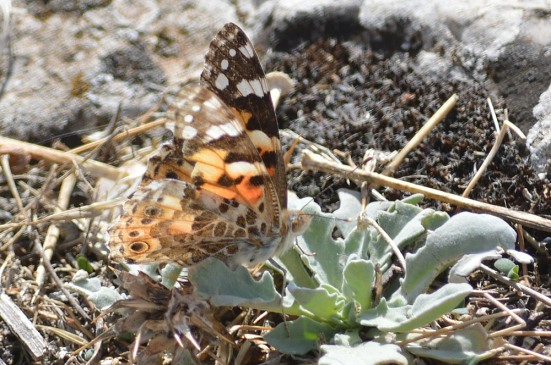
Red admiral underside

Red admiral underside

I spotted this Red admiral near the peak of Sv Nikola, up in the high country (628 metres). Good view of the underside of the wing. Red admirals also migrate, spending summer in northern Europe, and winter near the Mediterranean.

In Croatian, a butterfly is called a leptir, for once easy to remember as it’s clearly related to lepidoptera (from the ancient Greek  lepís=scale + pterón=wing). It’s less certain why the English saw any association with butter, though the name has been around for some time in old Dutch and German. Were there only yellow butterflies in northern Europe, I wonder?
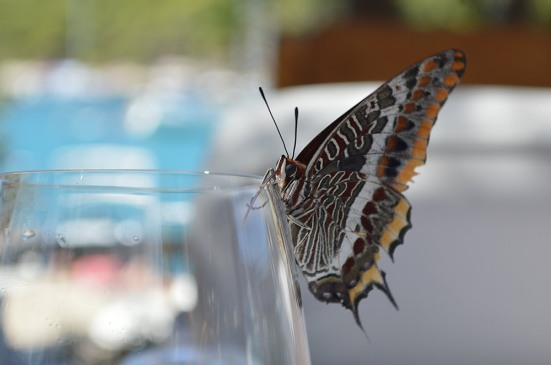
Two-tailed pasha also going for my wine

Charaxes jasius ~ Two-Tailed Pasha ~ vještica

Another butterfly that was keen to share our wine was this Two-tailed Pasha with exceptional taste at restaurant Laganini on Palmižana! It did, in fact, take a dive headfirst into my glass and had to be rescued at the expense of the wine!
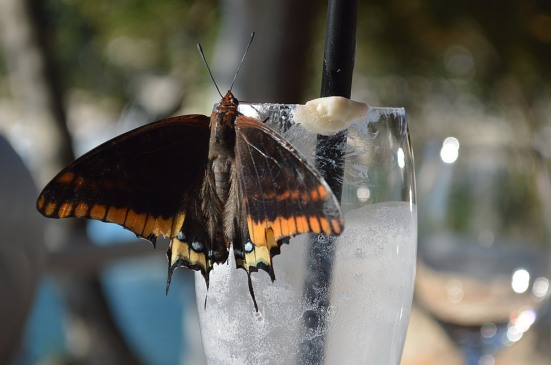
Two-tailed pasha

Two-Tailed Pasha enjoying some lemon sorbet

A fine butterfly, and a great poser with his proboscis stuck into a drop of lemon sorbet (with vodka and prosecco) for a good long drink! Two-tailed pashas produce two generations in a season, flying May/June and August/October. Clearly, they also like a drink!
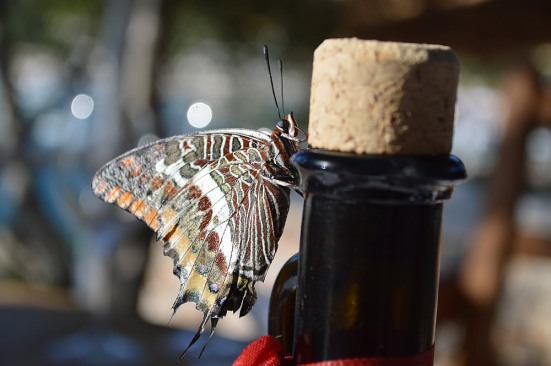
Two-tailed pasha underside

Two-tailed pasha underside and clear view of head

The beautiful colour of butterfly wings is due to the scales. While the dark blacks and browns are melanin pigments, and yellows come from uric acid and flavones, the other bright blues, greens, reds and iridescence are all caused by the structure of the scales and hairs.
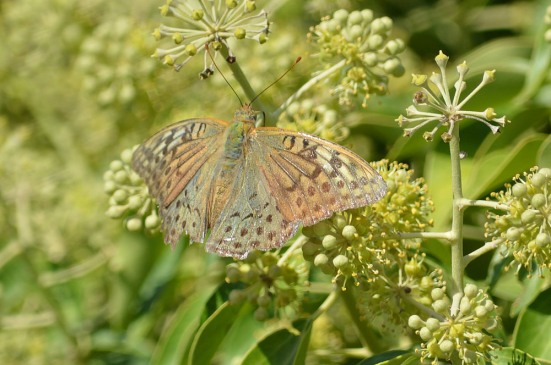
Cardinal

Argynnis pandora ~ Cardinal ~ Pandorin šarenac

Meanwhile, back at the popular ivy flowers, was this lovely Cardinal which is a fairly common butterfly around southern Europe from April to September. Sadly the photograph doesn’t quite do justice to the shimmer of that pale green colour. Very pretty in real life!
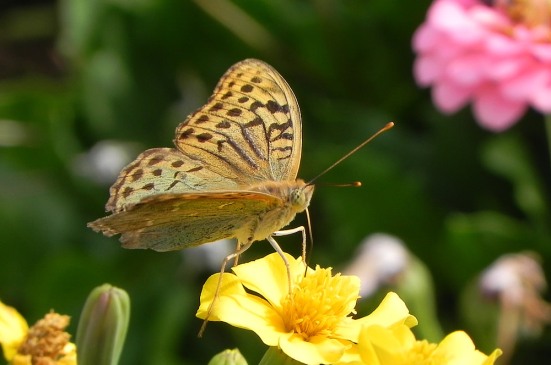
Cardinal in Stari Grad

Cardinal in Stari Grad

The second Cardinal was spotted in a garden in Stari Grad. Good view of the antennae, and the proboscis stuck into the flower. It looks to have only 4 legs, but that’s apparently normal for some types of butterflies, the front two legs are much reduced.
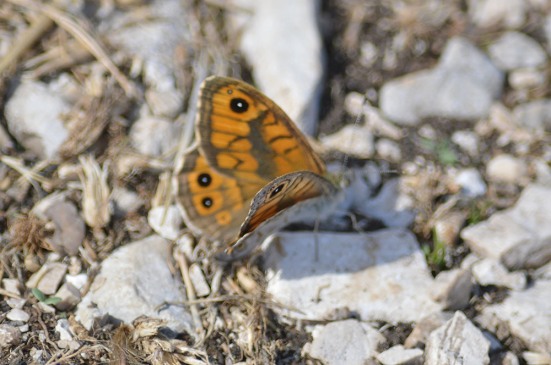
Wall brown

Lasiommata megera ~ Wall Brown ~ mali pjegavac

Hmmm, the field notes say the Wall brown is very alert and difficult to approach for taking photos – well, that’s certainly true! This guy was spotted beside the path on the way up to Sv Nikola, and this is the best photograph I could manage!

A recent (2011-13) study of butterflies on Hvar recorded 49 species, some of which are very rare within Croatia. All in all, 57 species have been recorded on Hvar, giving it 4th place among the islands for butterfly diversity. I have a long way to go to spot all those!

“Happiness is a butterfly, which when pursued, is always just beyond your grasp, but which, if you will sit down quietly, may alight upon you.”
~ Nathaniel Hawthorne

© Marion Podolski 2016

More about Croatia’s butterflies:

Project Noah: Butterflies and Moths of Croatia

Euro Butterflies by Matt Rowlings

Wikipedia list of butterflies and moths in Croatia

Annoted list of Croatian butterflies with vernacular names (PDF file for download)

Contribution to the knowledge of the butterfly fauna on the Adriatic island of Hvar, Croatia

This article has been reproduced with kind permission from Marion's blog Go Hvar, Ramblings about a far island. Visit the blog for all kinds of information about Hvar, from artistic to epicurean!

You are here: Home Nature Watch Hvar's Butterflies

Eco Environment News feeds

  • Boiler upgrade scheme, which provides grants of up to £9,000 for sustainable alternatives, expected to be slashed in budget

    When Bill Tuck first started installing air source heat pumps six years ago, other heating engineers were skeptical about whether the green technology would take off. “Now, the conversation is completely different,” he said.

    “I’m getting approached by them saying: ‘Mrs Jones, my customer for 15 years, she’s enquiring about a heat pump. What can you tell me?’ The whole narrative has changed.”

    Continue reading...

  • Oxfam says investing by rich in disaster recovery widens inequality and gives incentive to delay climate action

    The world’s wealthiest people are not just profiting from the polluting causes of climate breakdown, they are also increasingly cashing in on the catastrophic consequences, according to a study by Oxfam.

    The global equality organisation has found that the richest 0.1% of the world’s population are heavily invested in disaster preparedness, recovery and reconstruction – a market that is projected to grow from $70bn to $92bn a year by 2029.

    Continue reading...

  • President has taken an axe to National Oceanic and Atmospheric Administration, stalling climate research on and response to extreme weather events

    Sweeping cuts to the premier US climate agency under Donald Trump have severely hampered the country’s capacity to forecast, research and respond to extreme weather events, former government officials and scientists have warned, as the US faces a cascade of hazards fueled by a potentially historic El Niño this winter.

    From the start of his second term, the president has taken aim at the National Oceanic and Atmospheric Administration (Noaa), slashing staff levels, canceling contracts and grants, and shutting down databases and research laboratories. The agency that has long been considered a global crown jewel in climate science and forecasting, has lost roughly 20% of its staff since January 2025.

    Continue reading...

  • Letter to PM argues series of wrong choices on North Sea oil, Heathrow, EVs and heat pumps will scupper net zero plans

    Andy Burnham will “sleepwalk” into climate disaster if he fails to get a grip on a series of important policies whose combined impact could scupper plans to reach net zero, campaigners have said.

    Big decisions on North Sea drilling, the expansion of Heathrow airport, electric vehicles (EVs) and grants for heat pumps are awaiting decisions from ministers.

    Continue reading...

  • My mother was a keen swimmer, and she lived with depression. I wonder if she found the same respite in the water that has helped heal me since she passed away

    It was early morning in late September, off the coast of Kaş in Turkey. Watching the slightly choppy sea from a boat, the last thing I felt like doing was embarking on another 5km (3-mile) swim. Mind fog had sapped my energy, and my mood was decidedly Eeyore-like. But as I pulled on my cap and flippers, adjusted my goggles and took the plunge, something shifted.

    Head in the water, the knotted feeling in my throat began to loosen. Breathing came properly. There was respite.

    Continue reading...

  • Both private and public schools in tech regions are limiting the use of tech in classrooms. But will low-income districts be able to follow suit?

    German Gil spends most of his waking hours looking at screens. Since moving to the San Francisco Bay Area in 2015, the software engineer has bounced between start-ups and giants including Netflix, Facebook and GitHub.

    But when it came to the education of his daughter, Victoria, he wanted her to have a different experience, one in which his “kid could be a kid”.

    Continue reading...

  • Investigation finds dozens of ministers and civil servants moved into AI roles as government developed datacentre expansion plans

    The UK’s policy on datacentres and AI was developed without any meetings with environmental groups, an investigation has found.

    The nonprofit organisation Spotlight on Corruption said a “considerable revolving door” shaped the government’s development of “AI growth zones”, a central plank of the former prime minister Keir Starmer’s AI and economic policy, with 38 ministers, senior civil servants and special advisers hired to positions in AI companies between July 2024 and September 2026.

    Continue reading...

  • All it took was one or two careless teenage girls giving the vermin a taste of their snacks and they became the most well-fed animals imaginable

    I’ve written a fair amount about my boarding school years in Nigeria in the 90s, but never about the rats that accompanied my school experience. Picture it: thousands of girls from across the country, each bearing a suitcase or two of a term’s worth of “provisions” – cornflakes, sugar cubes, powdered milk, hot chocolate powder, and so on. All it took was one or two careless girls giving the rats a taste of the exotic and they became among the most well-fed rats in the country, enjoying a steady stream of delicious teenage-girl snacks.

    I will never forget the sight of rats – six or seven deep – congregating at dusk on the scraggly lawn next to my dormitory, like an illegal gathering of political dissidents. They were large (what with their rich diet), thick tails twitching, noses pushed together, damn near whispering. At first, they would scatter when humans approached. Then we had to clap and stomp to get them to shift. Like the proletariat, the rats began to understand their power, and stand their ground. They were no longer pests but now a sort of predator. If this sounds like the beginning of a highbrow horror, that’s how it felt.

    Continue reading...

  • Company imitates reflection of sun from mirrors, prompting pushback from some scientists, environmentalists and California locals

    Locals in a rural area of California were recently startled to see dazzlingly bright light shining down from nearby mountains at night, illuminating a swathe of the desert below.

    Unbeknown to them, the strange nocturnal illumination was the latest step in a company’s plan to erect thousands of giant mirrors in space to reflect sunlight on to the Earth during night-time.

    Continue reading...

  • Concrete sprawl in Yaoundé has devastated the city’s trees and parks, so volunteers are stepping up, shrub by shrub

    A little piece of paradise is buried under the asphalt that is now lined with parked cars. The romantic spot where Sosthène Hugues Ngono used to bring his first dates had been green and beautiful. “It wasn’t just a park,” he says, standing at the edge of what is now a private car park in Cameroon’s capital, Yaoundé.

    “It was where I came to clear my head when things felt confused,” he says. “Where I met people; where I fell in love, more than once.”

    Continue reading...

Eco Health News feeds

Eco Nature News feeds