Hvar's Butterflies

Marion Podolski casts her expert artistic eye over Hvar's butterflies.

Hvar butterfly at work, July 2016 Hvar butterfly at work, July 2016 Vivian Grisogono

Butterflies always seem so fragile, so transient. So it came as quite the surprise when I read that (a) there are butterfly fossils dating back around 56 million years, and (b) the Painted Lady appears to hold the record for the longest return migration, from Africa to the Arctic circle and back!
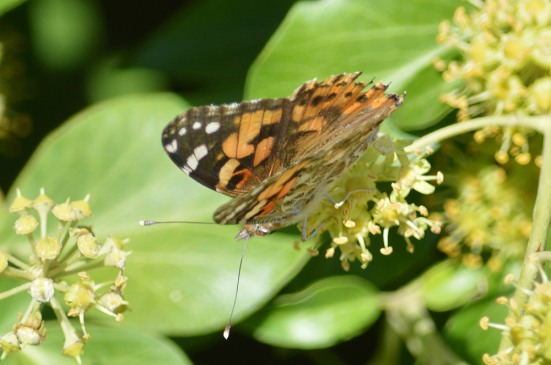
Painted lady

Vanessa cardui ~ Painted lady ~ Stričkovac

This photograph was taken at Vorh on Hvar, altitude around 500 metres. European ivy is known for having flowers high in nectar, and was swarming with butterflies and bees in September. The Painted lady migrates from North Africa and the Mediterranean northwards in the springtime, and southwards in the autumn. The 9,000 mile round trip between tropical Africa and the Arctic circle may take as many as 6 generations! Was this butterfly on a refuelling stop for its Autumn migration?

This summer I’ve been more aware of butterflies on Hvar, possibly due to my recent interest in wildflowers. It’s a good sign, as flowers and butterflies mean a healthy ecosystem. Though sometimes they were nowhere near any flowers!
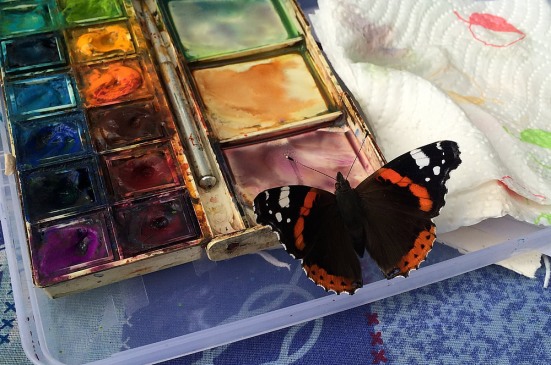
Red admiral

Vanessa atalanta ~ Red Admiral ~ Ljepokrili admiral

As I was sitting on the Soline beach near Vrboska, painting with my art group, this visitor was very interested in my paintbox! Luckily I had my phone to hand, and managed to capture the moment! And as I didn’t really feel that paints were proper nourishment, being toxic and all, I closed up the box, so it decided to try some wine instead!
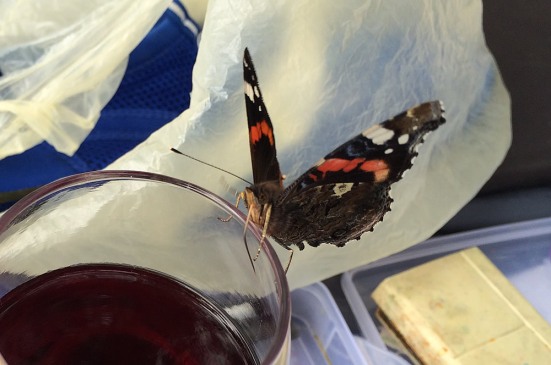
Red admiral likes a glass of wine

My Red admiral likes a glass of wine!

While some (adult) butterflies live only for a few days, other species survive for almost a full year. Those living longer can feed on nectar from flowers, and they are in fact important pollinators for some kinds of plants. Although they can’t carry as much pollen as bees, they are able to take it over longer distances. They’ll also sip water (and wine!), are sometimes  attracted to dung, rotting fruit, or the salt in human sweat for other essential minerals and nutrients. Their “taste” receptors are apparently located on their feet, so they can determine whether a leaf is suitable for laying eggs on (ie the caterpillar kids can eat it!)
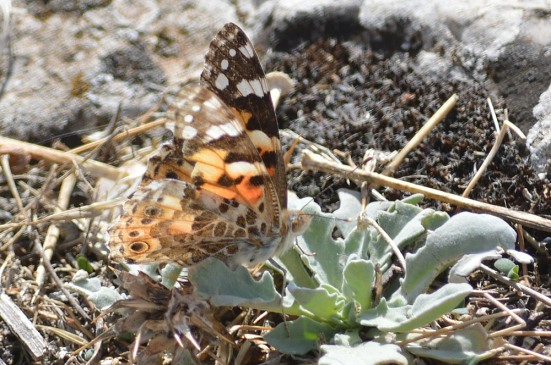
Red admiral underside

Red admiral underside

I spotted this Red admiral near the peak of Sv Nikola, up in the high country (628 metres). Good view of the underside of the wing. Red admirals also migrate, spending summer in northern Europe, and winter near the Mediterranean.

In Croatian, a butterfly is called a leptir, for once easy to remember as it’s clearly related to lepidoptera (from the ancient Greek  lepís=scale + pterón=wing). It’s less certain why the English saw any association with butter, though the name has been around for some time in old Dutch and German. Were there only yellow butterflies in northern Europe, I wonder?
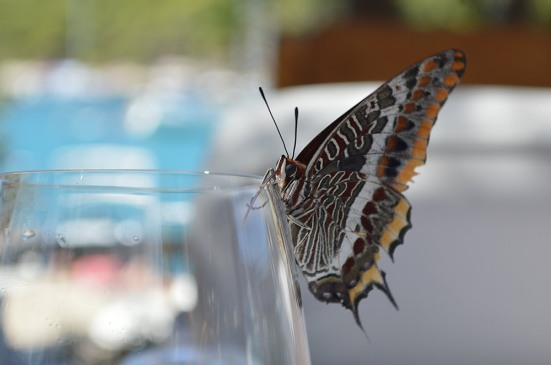
Two-tailed pasha also going for my wine

Charaxes jasius ~ Two-Tailed Pasha ~ vještica

Another butterfly that was keen to share our wine was this Two-tailed Pasha with exceptional taste at restaurant Laganini on Palmižana! It did, in fact, take a dive headfirst into my glass and had to be rescued at the expense of the wine!
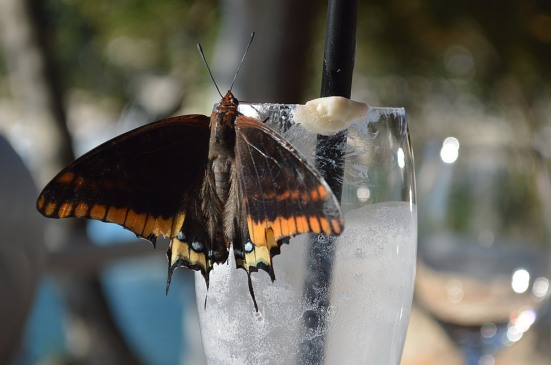
Two-tailed pasha

Two-Tailed Pasha enjoying some lemon sorbet

A fine butterfly, and a great poser with his proboscis stuck into a drop of lemon sorbet (with vodka and prosecco) for a good long drink! Two-tailed pashas produce two generations in a season, flying May/June and August/October. Clearly, they also like a drink!
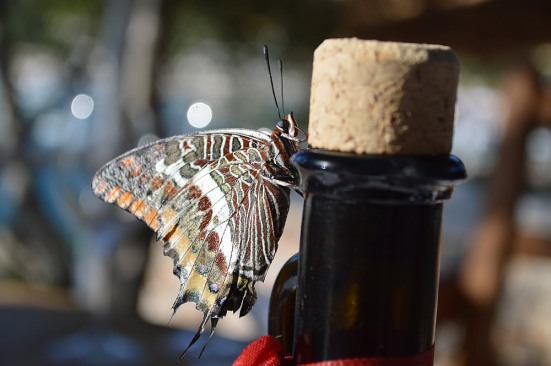
Two-tailed pasha underside

Two-tailed pasha underside and clear view of head

The beautiful colour of butterfly wings is due to the scales. While the dark blacks and browns are melanin pigments, and yellows come from uric acid and flavones, the other bright blues, greens, reds and iridescence are all caused by the structure of the scales and hairs.
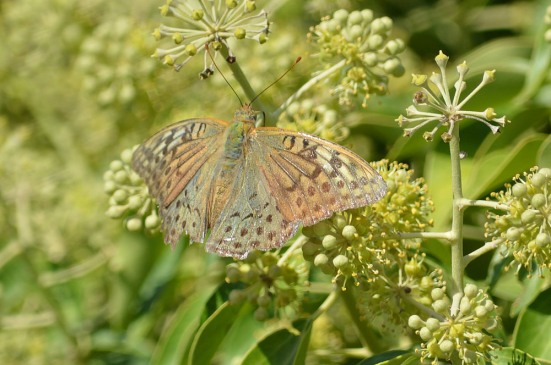
Cardinal

Argynnis pandora ~ Cardinal ~ Pandorin šarenac

Meanwhile, back at the popular ivy flowers, was this lovely Cardinal which is a fairly common butterfly around southern Europe from April to September. Sadly the photograph doesn’t quite do justice to the shimmer of that pale green colour. Very pretty in real life!
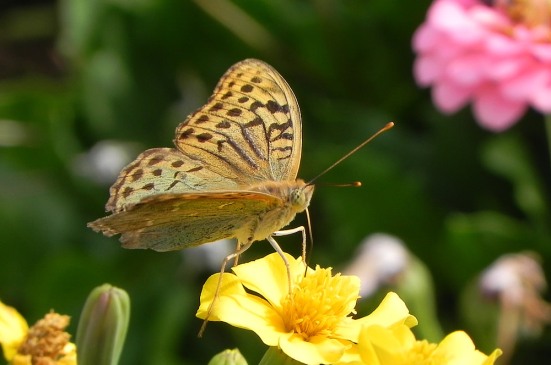
Cardinal in Stari Grad

Cardinal in Stari Grad

The second Cardinal was spotted in a garden in Stari Grad. Good view of the antennae, and the proboscis stuck into the flower. It looks to have only 4 legs, but that’s apparently normal for some types of butterflies, the front two legs are much reduced.
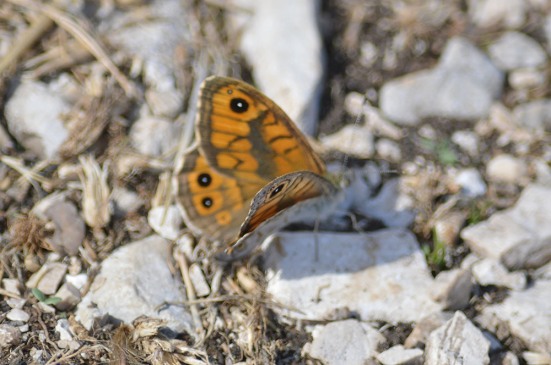
Wall brown

Lasiommata megera ~ Wall Brown ~ mali pjegavac

Hmmm, the field notes say the Wall brown is very alert and difficult to approach for taking photos – well, that’s certainly true! This guy was spotted beside the path on the way up to Sv Nikola, and this is the best photograph I could manage!

A recent (2011-13) study of butterflies on Hvar recorded 49 species, some of which are very rare within Croatia. All in all, 57 species have been recorded on Hvar, giving it 4th place among the islands for butterfly diversity. I have a long way to go to spot all those!

“Happiness is a butterfly, which when pursued, is always just beyond your grasp, but which, if you will sit down quietly, may alight upon you.”
~ Nathaniel Hawthorne

© Marion Podolski 2016

More about Croatia’s butterflies:

Project Noah: Butterflies and Moths of Croatia

Euro Butterflies by Matt Rowlings

Wikipedia list of butterflies and moths in Croatia

Annoted list of Croatian butterflies with vernacular names (PDF file for download)

Contribution to the knowledge of the butterfly fauna on the Adriatic island of Hvar, Croatia

This article has been reproduced with kind permission from Marion's blog Go Hvar, Ramblings about a far island. Visit the blog for all kinds of information about Hvar, from artistic to epicurean!

You are here: Home Nature Watch Hvar's Butterflies

Eco Environment News feeds

  • V2G tech enables drivers to charge automatically when electricity is cheaper and then sell some back to the grid at times of high demand

    Electric cars that can be used as “power plants on wheels” could be given government backing as part of plans under consideration to help UK manufacturers.

    Ministers are considering giving manufacturers incentives to add “vehicle to grid” (V2G) technology to cars as part of its review of the zero-emission vehicle (ZEV) mandate.

    Continue reading...

  • Chancellor is in favour of North Sea project, but energy secretary has said she is leaning towards rejecting it

    A cabinet split has emerged over whether to approve drilling at the Rosebank oilfield, with the chancellor, John Healey, in favour of the controversial North Sea project.

    The energy secretary, Miatta Fahnbulleh, is ultimately in charge of the decision, and the Guardian reported last week that she was leaning towards rejecting it after granting permission for the smaller Jackdaw gasfield.

    Continue reading...

  • Concrete sprawl in Yaoundé has devastated the city’s trees and parks, so volunteers are stepping up, shrub by shrub

    A little piece of paradise is buried under the asphalt that is now lined with parked cars. The romantic spot where Sosthène Hugues Ngono used to bring his first dates had been green and beautiful. “It wasn’t just a park,” he says, standing at the edge of what is now a private car park in Cameroon’s capital, Yaoundé.

    “It was where I came to clear my head when things felt confused,” he says. “Where I met people; where I fell in love, more than once.”

    Continue reading...

  • Eldwick Crag, West Yorkshire: In the low light and the high wind, these corvids are preparing to roost for the night. And they seem to be enjoying themselves

    Jackdaws like blustery weather the same way dolphins love choppy seas. There are faster flyers and more graceful flyers, but I can’t think of a bird that just enjoys flying as much as a jackdaw does. They bob and bank and yaw and wheel. And right now it’s roosting time in the copse above the quarry.

    A jackdaw roost – or rather the prelude to the roost, the bedtime gathering, the swirl of small, clacking crows above and about the trees, like particles about to be drawn into a plughole – isn’t a murmuration. It’s neither as spectacular nor as enigmatic as the twilight displays of starlings; it’s a flock, plain and simple (plain as the jackdaw’s call of its own name, “jack”). But like everything jackdaws do, it’s full of bustling, garrulous life.

    Continue reading...

  • Every autumn, Corvo Island in the Azores turns off its public lighting for a few key days to help fledgling Cory’s shearwaters as they attempt to fly to the ocean guided by the stars

    Once a year, Corvo, the smallest and most northerly island of Portugal’s Azores archipelago, goes dark. Since 2019, the island’s 450 or so inhabitants have chosen to switch off the lights every autumn for five nights to tackle the disastrous effects of artificial light on Cory’s shearwaters, a seabird endemic to the Atlantic Ocean.

    It began in 1991 when the community noticed huge numbers of deaths among young shearwaters.

    A newborn Cory’s shearwater chick

    Continue reading...

  • The 2030 target for 80% of new cars to have zero emissions could be cut to as low as half

    Electric cars make people happy. More than nine in 10 EV drivers – 94% in a recent poll – are saving money, and a similar number would stick with electric for their next purchase, and recommend them to family and friends. Sales are soaring: more than half of the new cars sold in the UK last month were electric, if hybrids are taken into account, and about 28% of new car sales overall were electric only.

    This is hardly surprising, given that soaring petrol and diesel costs have pushed up the price of a full tank to about £120. EV drivers are paying about 2.4p a mile.

    Continue reading...

  • Tim and Geli Harris have spent more than a decade fighting to protect Catfield Fen, a rare wetland in the Norfolk Broads

    Polluters and regulators who fail to stop pollution must quake in their boots when they receive a letter from the lawyers for Tim and Geli Harris. The couple, who farm 460 acres in the Norfolk Broads, have now scored a hat-trick of landmark legal victories to save an internationally important wetland after they won again in the high court this month.

    Lady Justice Lieven found that Natural England failed in its statutory duty to protect Catfield Fen from pollution after nitrates and phosphates washed from arable fields into one of the finest examples of calcareous fen in western Europe, home to 2,500 species including rarities such as the fen orchid, crested buckler fern, breeding bittern and swallowtail butterflies.

    Continue reading...

  • Company imitates reflection of sun from mirrors, prompting pushback from some scientists, environmentalists and California locals

    Locals in a rural area of California were recently startled to see dazzlingly bright light shining down from nearby mountains at night, illuminating a swathe of the desert below.

    Unbeknown to them, the strange nocturnal illumination was the latest step in a company’s plan to erect thousands of giant mirrors in space to reflect sunlight on to the Earth during night-time.

    Continue reading...

  • Queensland researchers say a published study contains ‘silly mistake’ that over-inflates vaccine’s efficacy but the regulator is standing by decision to approve it

    At wildlife hospitals across eastern Australia, many koalas brought in have distinctive brown patches on their bottoms – a sign of urinary incontinence and a painful inflamed bladder. Others have red, weeping eyes, pointing to a bacterial disease that can cause blindness in the endangered marsupials.

    Chlamydia infection, also known as chlamydiosis, is the most significant disease affecting the animals. The culprit is most commonly the bacterium Chlamydia pecorum, which is spread via mating or close contact.

    Continue reading...

  • Dom Phillips warned that Jair Bolsonaro would make life more dangerous for reporters and the Amazon rainforest, and that his sons were even more extreme

    “Bolso shows all signs of fascism, as do his supporters,” the murdered British journalist Dom Phillips told me before his death. “His sons are all more extreme if anything.”

    These words were written in 2018 by the Guardian contributor shortly before the election of the far-right former army captain Jair Bolsonaro as president of Brazil – a prospect that Dom viewed with dread.

    Continue reading...

Eco Health News feeds

Eco Nature News feeds