Hvar's Butterflies

Marion Podolski casts her expert artistic eye over Hvar's butterflies.

Hvar butterfly at work, July 2016 Hvar butterfly at work, July 2016 Vivian Grisogono

Butterflies always seem so fragile, so transient. So it came as quite the surprise when I read that (a) there are butterfly fossils dating back around 56 million years, and (b) the Painted Lady appears to hold the record for the longest return migration, from Africa to the Arctic circle and back!
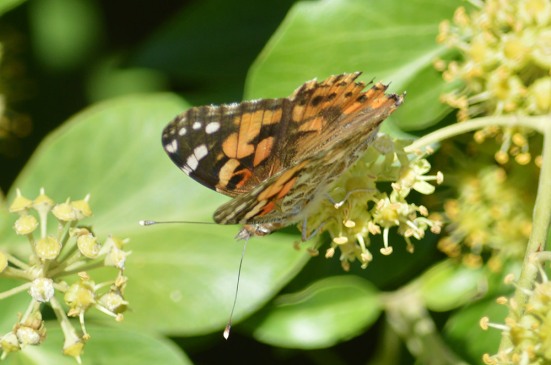
Painted lady

Vanessa cardui ~ Painted lady ~ Stričkovac

This photograph was taken at Vorh on Hvar, altitude around 500 metres. European ivy is known for having flowers high in nectar, and was swarming with butterflies and bees in September. The Painted lady migrates from North Africa and the Mediterranean northwards in the springtime, and southwards in the autumn. The 9,000 mile round trip between tropical Africa and the Arctic circle may take as many as 6 generations! Was this butterfly on a refuelling stop for its Autumn migration?

This summer I’ve been more aware of butterflies on Hvar, possibly due to my recent interest in wildflowers. It’s a good sign, as flowers and butterflies mean a healthy ecosystem. Though sometimes they were nowhere near any flowers!
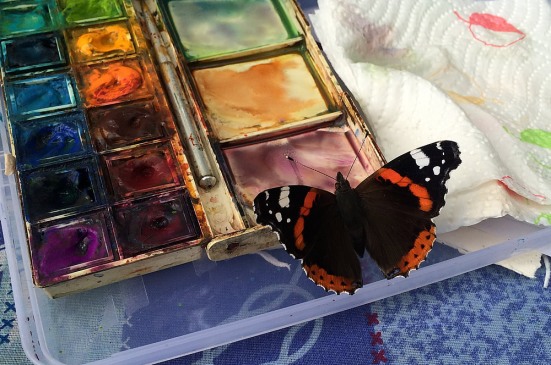
Red admiral

Vanessa atalanta ~ Red Admiral ~ Ljepokrili admiral

As I was sitting on the Soline beach near Vrboska, painting with my art group, this visitor was very interested in my paintbox! Luckily I had my phone to hand, and managed to capture the moment! And as I didn’t really feel that paints were proper nourishment, being toxic and all, I closed up the box, so it decided to try some wine instead!
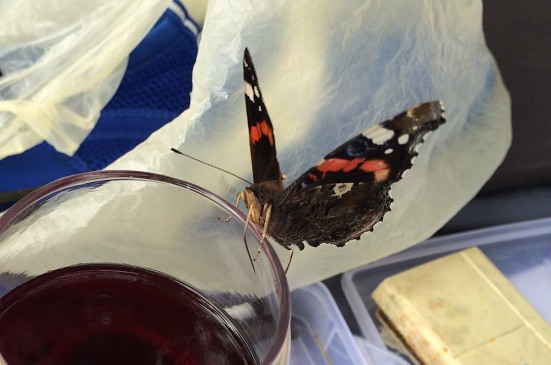
Red admiral likes a glass of wine

My Red admiral likes a glass of wine!

While some (adult) butterflies live only for a few days, other species survive for almost a full year. Those living longer can feed on nectar from flowers, and they are in fact important pollinators for some kinds of plants. Although they can’t carry as much pollen as bees, they are able to take it over longer distances. They’ll also sip water (and wine!), are sometimes  attracted to dung, rotting fruit, or the salt in human sweat for other essential minerals and nutrients. Their “taste” receptors are apparently located on their feet, so they can determine whether a leaf is suitable for laying eggs on (ie the caterpillar kids can eat it!)
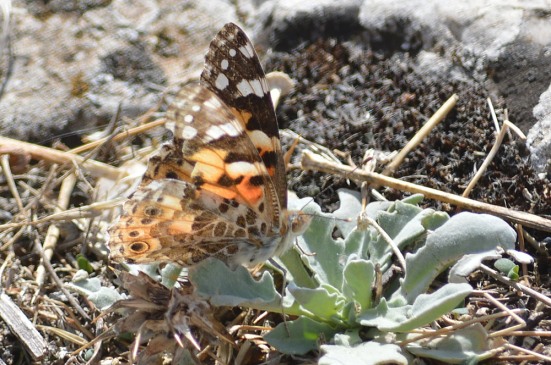
Red admiral underside

Red admiral underside

I spotted this Red admiral near the peak of Sv Nikola, up in the high country (628 metres). Good view of the underside of the wing. Red admirals also migrate, spending summer in northern Europe, and winter near the Mediterranean.

In Croatian, a butterfly is called a leptir, for once easy to remember as it’s clearly related to lepidoptera (from the ancient Greek  lepís=scale + pterón=wing). It’s less certain why the English saw any association with butter, though the name has been around for some time in old Dutch and German. Were there only yellow butterflies in northern Europe, I wonder?
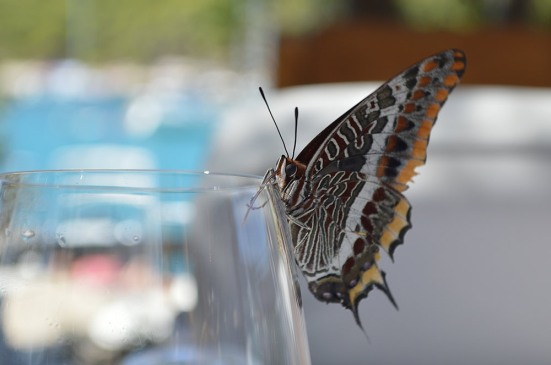
Two-tailed pasha also going for my wine

Charaxes jasius ~ Two-Tailed Pasha ~ vještica

Another butterfly that was keen to share our wine was this Two-tailed Pasha with exceptional taste at restaurant Laganini on Palmižana! It did, in fact, take a dive headfirst into my glass and had to be rescued at the expense of the wine!
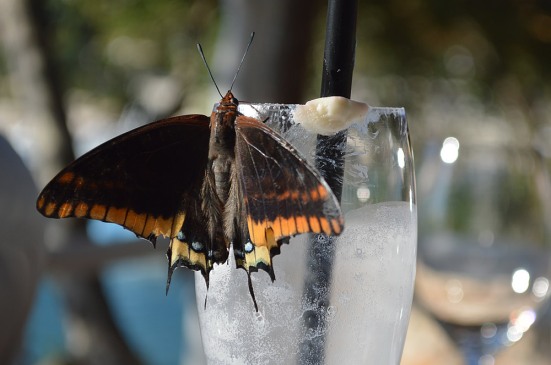
Two-tailed pasha

Two-Tailed Pasha enjoying some lemon sorbet

A fine butterfly, and a great poser with his proboscis stuck into a drop of lemon sorbet (with vodka and prosecco) for a good long drink! Two-tailed pashas produce two generations in a season, flying May/June and August/October. Clearly, they also like a drink!
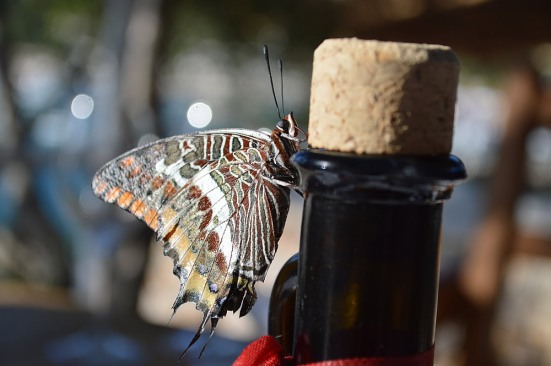
Two-tailed pasha underside

Two-tailed pasha underside and clear view of head

The beautiful colour of butterfly wings is due to the scales. While the dark blacks and browns are melanin pigments, and yellows come from uric acid and flavones, the other bright blues, greens, reds and iridescence are all caused by the structure of the scales and hairs.
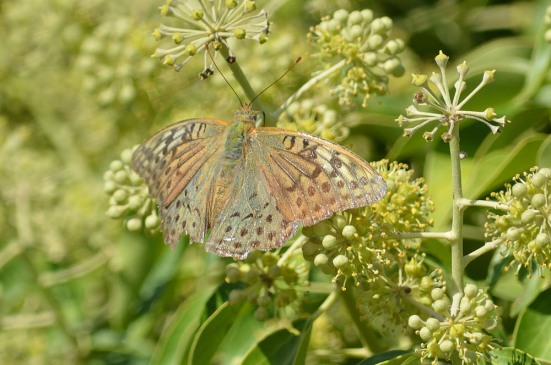
Cardinal

Argynnis pandora ~ Cardinal ~ Pandorin šarenac

Meanwhile, back at the popular ivy flowers, was this lovely Cardinal which is a fairly common butterfly around southern Europe from April to September. Sadly the photograph doesn’t quite do justice to the shimmer of that pale green colour. Very pretty in real life!
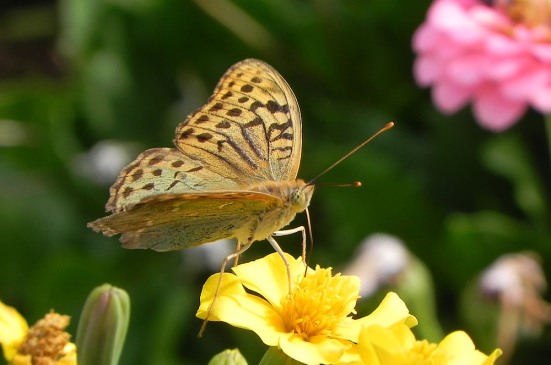
Cardinal in Stari Grad

Cardinal in Stari Grad

The second Cardinal was spotted in a garden in Stari Grad. Good view of the antennae, and the proboscis stuck into the flower. It looks to have only 4 legs, but that’s apparently normal for some types of butterflies, the front two legs are much reduced.
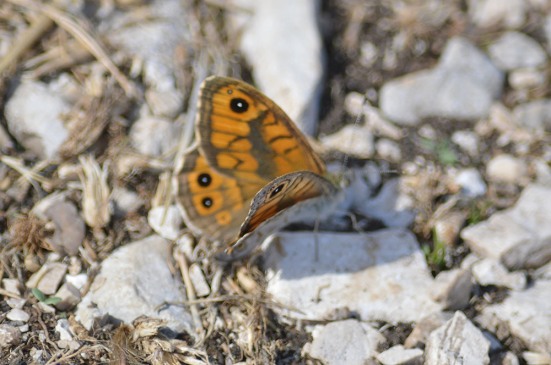
Wall brown

Lasiommata megera ~ Wall Brown ~ mali pjegavac

Hmmm, the field notes say the Wall brown is very alert and difficult to approach for taking photos – well, that’s certainly true! This guy was spotted beside the path on the way up to Sv Nikola, and this is the best photograph I could manage!

A recent (2011-13) study of butterflies on Hvar recorded 49 species, some of which are very rare within Croatia. All in all, 57 species have been recorded on Hvar, giving it 4th place among the islands for butterfly diversity. I have a long way to go to spot all those!

“Happiness is a butterfly, which when pursued, is always just beyond your grasp, but which, if you will sit down quietly, may alight upon you.”
~ Nathaniel Hawthorne

© Marion Podolski 2016

More about Croatia’s butterflies:

Project Noah: Butterflies and Moths of Croatia

Euro Butterflies by Matt Rowlings

Wikipedia list of butterflies and moths in Croatia

Annoted list of Croatian butterflies with vernacular names (PDF file for download)

Contribution to the knowledge of the butterfly fauna on the Adriatic island of Hvar, Croatia

This article has been reproduced with kind permission from Marion's blog Go Hvar, Ramblings about a far island. Visit the blog for all kinds of information about Hvar, from artistic to epicurean!

You are here: Home Nature Watch Hvar's Butterflies

Eco Environment News feeds

  • Authorities say water rising at lake at site of disaster and it could burst

    Eyewitness accounts have been emerging from the Tibetan side of the border, with a woman saying she was travelling from Gyirong town towards Nepal on Wednesday morning when her group encountered the flood about 4km from Gyirong port.

    “Trees and electricity poles had already been knocked down, and the flood water was bearing down on us. We didn’t dare turn around, so we could only reverse,” the woman, surnamed Fang, told Xiaoxiang Morning News.

    I was really scared. My whole body was trembling.

    Continue reading...

  • Horticulturalists begin moving and propagating plants before the rusty and warped Palm House begins renovation – but some are too tall to save

    It will be a gut-wrenching moment for the horticulturalists at Kew Gardens when some of the magnificent trees in the Palm House have to be felled.

    “There are some sad moments ahead,” said Palm House manager, Will Spoelstra, who knows all the plants inside the cathedral-like greenhouse.

    Continue reading...

  • Exclusive: utility company wants to draw off tens of millions of litres of water a day from Thames and replace it with treated effluent

    Levels of a toxic “forever chemical” rose to 13 times the legal limit during Thames Water pilots for a controversial multimillion pound water recycling scheme that will pump millions of litres of treated sewage into the River Thames during drought.

    The data from the pilots is in stark contrast to public comments from Thames Water that their water recycling project in south-west London will not harm the riverine environment.

    Continue reading...

  • Our buildings are monuments to extraction and extreme emissions. But what if we turned from destructive concrete to timber?

    • Last chance to buy the summer issue of The Long Read magazine, now with 15% off. Click here to order

    I travelled to Oslo in the early autumn. It felt like arriving into the future. Or, at least, a fragment of a possible future. I drove north in the quiet digital bubble of my electric rental car. In 2024, Norway became the first country in the world where electric cars outnumbered petrol cars.

    A smooth, pristine motorway unfolded between farmlands and low hillsides of dense green forest. Long tunnels carried the route up above the banks of Lake Mjøsa, Norway’s largest lake. After a little more than an hour, the road curved downward to run parallel to the lakeshore.

    Continue reading...

  • Bears killed 13 people in Japan last year, as a lack of forest foods increased conflicts. Yet some say the country’s controversial cull could threaten the endangered species

    Every summer, millions of people escape the heat and humidity of Tokyo by heading to the tranquil resort town of Karuizawa in Japan’s Nagano prefecture – just an hour by bullet train from the capital. Here, at the foot of Mount Asama, visitors stroll bamboo-lined pathways, cycle in verdant highlands, and practise the wellness ritual of shinrin-yoku,bathing among the cool hinoki forests. It would be the ideal nature retreat – if it wasn’t for the bears.

    From June to August, bears often move close to Karuizawa, feeding on the mulberries, ants, leaves and cherry blossoms that grow near the town. Unlike nuts, these foods are low in calories, spurring the bears to seek out further sustenance. “They’re more likely to get close to residential spaces to see what they can find,” says Amelia Hiorns, a British zoologist who previously worked with Picchio Wildlife Research Centre in the town. “This combines with the busiest season for tourists.”

    Continue reading...

  • Investment in climate-resilient irrigation enables this year’s haul to rise 6% on 2025’s already bigger-than-usual yield

    British farmers have faced a sweltering summer tested by heatwaves, wildfires and water shortages – but a bumper berry harvest could prove a rare bright spot.

    With two-thirds of the harvest now picked, this year’s haul is 6% up on last year’s already unusually large crop, according to British Berry Growers (BBG). Volumes of blackberries, blueberries and raspberries picked have been particularly strong, the trade body said.

    Continue reading...

  • Steel rails warping and signalling equipment failing in metal cabinets are among the problems to be solved

    Tarmac softens in the summer heat, which may cause problems on the roads, but even trains running on steel rails are not immune.

    Railways in the UK are generally designed to operate within a 45C temperature range. The rails expand slightly in the heat, and excessive temperatures can produce “sun kink” with rails warping into S-shapes. The effect is small but the distortion can derail fast trains, so speeds are reduced for safety.

    Continue reading...

  • Lethal temperatures ​and wildfires have exposed a widening gulf between voters demanding ​action and politicians unwilling to confront the long-term choices global heating requires

    Don’t get This Is Europe delivered to your inbox? Sign up here

    The climate crisis means “we’re going to have to change everything – the way we live, the way we produce, the way we trade,” France’s veteran radical-left firebrand, Jean-Luc Mélenchon, told the summer congress of his France Insoumise party last weekend.

    The term “climate change”, said Mélenchon – the most likely rival to Marine Le Pen in next year’s presidential run-off, according to one poll this week – may sound “almost reassuring”, but its actual impact will feel like “landing on another planet whenever we leave home”.

    Continue reading...

  • A magical corner of Oregon has the highest US rate of wildfire smoke deaths. How do residents live with the haze – and grief?

    Driving into the county, you can’t miss the sign.

    “IT’S THE CLIMATE”.

    Continue reading...

  • Jack Klein takes heat readings, gives fans to overheated passengers and lugs big jugs of water into the stations

    On a recent August day in the subterranean furnace of New York City’s subway, one bearded, curly-haired man was studying his phone for different reasons than the other wilting passengers – to track the soaring temperatures and ponder how underground train stations can cool down in an era of climate crisis.

    Jack Klein, a 31-year-old construction site manager, has in the past two years taken it upon himself to become a sort of guerrilla subway heat operative, sticking teardrop-shaped thermometers to steel beams in seven of the hottest Manhattan stations and posting social media videos of the hades-like summer temperatures that commuters have to endure.

    Continue reading...

Eco Health News feeds

Eco Nature News feeds