Hvar's Butterflies

Marion Podolski casts her expert artistic eye over Hvar's butterflies.

Hvar butterfly at work, July 2016 Hvar butterfly at work, July 2016 Vivian Grisogono

Butterflies always seem so fragile, so transient. So it came as quite the surprise when I read that (a) there are butterfly fossils dating back around 56 million years, and (b) the Painted Lady appears to hold the record for the longest return migration, from Africa to the Arctic circle and back!
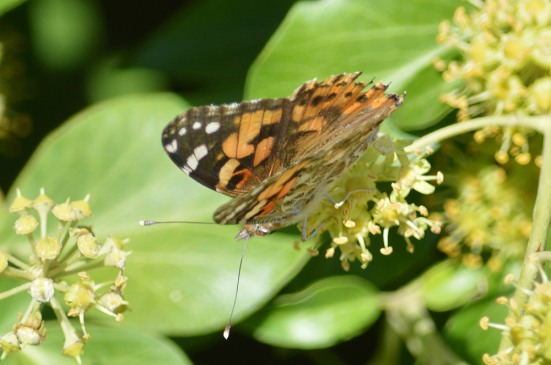
Painted lady

Vanessa cardui ~ Painted lady ~ Stričkovac

This photograph was taken at Vorh on Hvar, altitude around 500 metres. European ivy is known for having flowers high in nectar, and was swarming with butterflies and bees in September. The Painted lady migrates from North Africa and the Mediterranean northwards in the springtime, and southwards in the autumn. The 9,000 mile round trip between tropical Africa and the Arctic circle may take as many as 6 generations! Was this butterfly on a refuelling stop for its Autumn migration?

This summer I’ve been more aware of butterflies on Hvar, possibly due to my recent interest in wildflowers. It’s a good sign, as flowers and butterflies mean a healthy ecosystem. Though sometimes they were nowhere near any flowers!
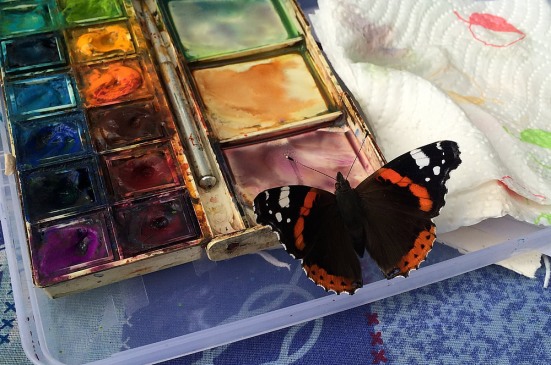
Red admiral

Vanessa atalanta ~ Red Admiral ~ Ljepokrili admiral

As I was sitting on the Soline beach near Vrboska, painting with my art group, this visitor was very interested in my paintbox! Luckily I had my phone to hand, and managed to capture the moment! And as I didn’t really feel that paints were proper nourishment, being toxic and all, I closed up the box, so it decided to try some wine instead!
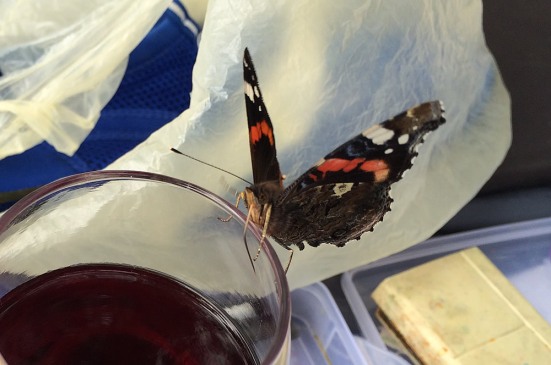
Red admiral likes a glass of wine

My Red admiral likes a glass of wine!

While some (adult) butterflies live only for a few days, other species survive for almost a full year. Those living longer can feed on nectar from flowers, and they are in fact important pollinators for some kinds of plants. Although they can’t carry as much pollen as bees, they are able to take it over longer distances. They’ll also sip water (and wine!), are sometimes  attracted to dung, rotting fruit, or the salt in human sweat for other essential minerals and nutrients. Their “taste” receptors are apparently located on their feet, so they can determine whether a leaf is suitable for laying eggs on (ie the caterpillar kids can eat it!)
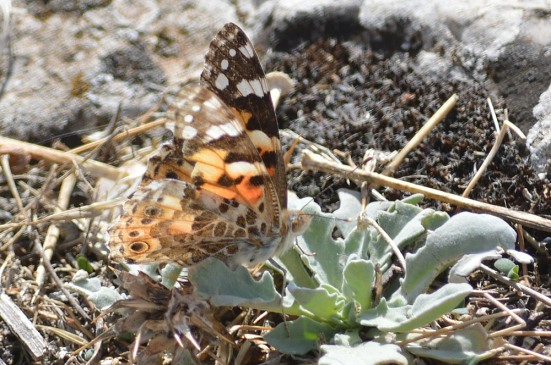
Red admiral underside

Red admiral underside

I spotted this Red admiral near the peak of Sv Nikola, up in the high country (628 metres). Good view of the underside of the wing. Red admirals also migrate, spending summer in northern Europe, and winter near the Mediterranean.

In Croatian, a butterfly is called a leptir, for once easy to remember as it’s clearly related to lepidoptera (from the ancient Greek  lepís=scale + pterón=wing). It’s less certain why the English saw any association with butter, though the name has been around for some time in old Dutch and German. Were there only yellow butterflies in northern Europe, I wonder?
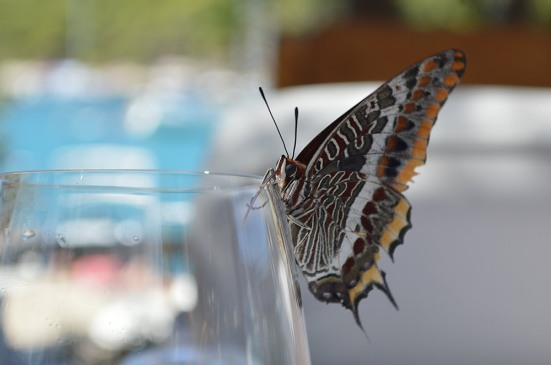
Two-tailed pasha also going for my wine

Charaxes jasius ~ Two-Tailed Pasha ~ vještica

Another butterfly that was keen to share our wine was this Two-tailed Pasha with exceptional taste at restaurant Laganini on Palmižana! It did, in fact, take a dive headfirst into my glass and had to be rescued at the expense of the wine!
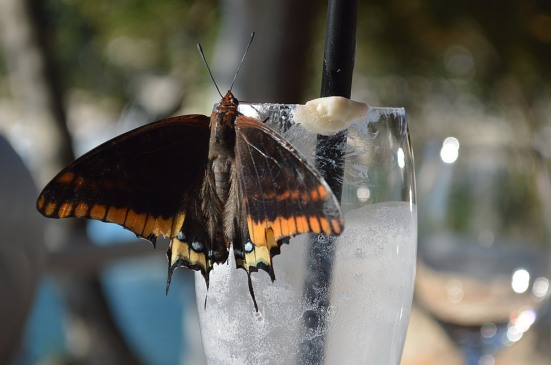
Two-tailed pasha

Two-Tailed Pasha enjoying some lemon sorbet

A fine butterfly, and a great poser with his proboscis stuck into a drop of lemon sorbet (with vodka and prosecco) for a good long drink! Two-tailed pashas produce two generations in a season, flying May/June and August/October. Clearly, they also like a drink!
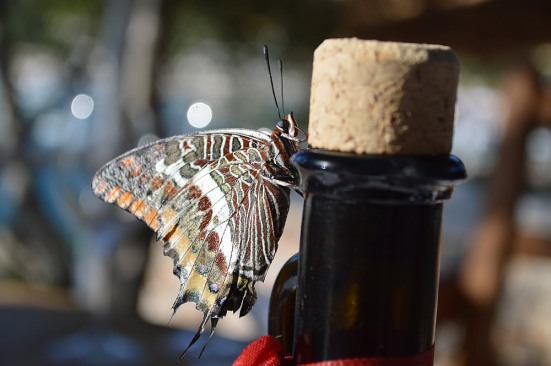
Two-tailed pasha underside

Two-tailed pasha underside and clear view of head

The beautiful colour of butterfly wings is due to the scales. While the dark blacks and browns are melanin pigments, and yellows come from uric acid and flavones, the other bright blues, greens, reds and iridescence are all caused by the structure of the scales and hairs.
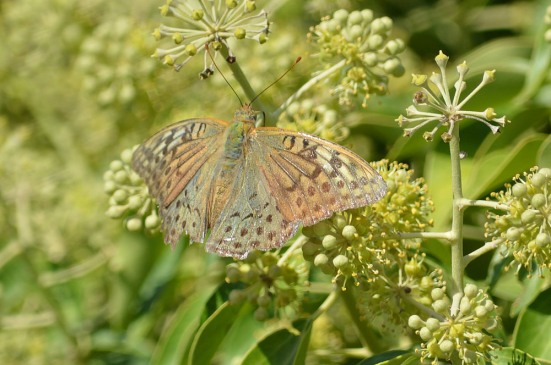
Cardinal

Argynnis pandora ~ Cardinal ~ Pandorin šarenac

Meanwhile, back at the popular ivy flowers, was this lovely Cardinal which is a fairly common butterfly around southern Europe from April to September. Sadly the photograph doesn’t quite do justice to the shimmer of that pale green colour. Very pretty in real life!
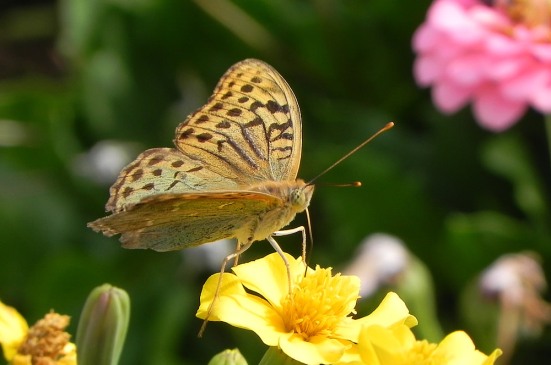
Cardinal in Stari Grad

Cardinal in Stari Grad

The second Cardinal was spotted in a garden in Stari Grad. Good view of the antennae, and the proboscis stuck into the flower. It looks to have only 4 legs, but that’s apparently normal for some types of butterflies, the front two legs are much reduced.
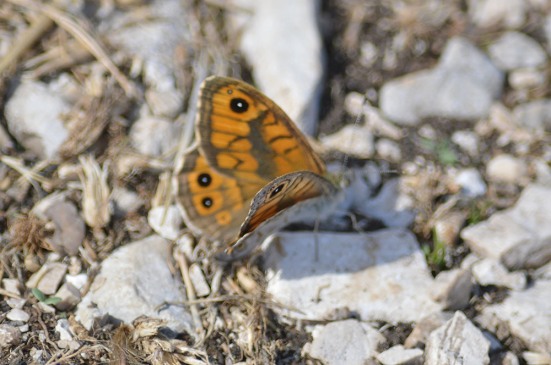
Wall brown

Lasiommata megera ~ Wall Brown ~ mali pjegavac

Hmmm, the field notes say the Wall brown is very alert and difficult to approach for taking photos – well, that’s certainly true! This guy was spotted beside the path on the way up to Sv Nikola, and this is the best photograph I could manage!

A recent (2011-13) study of butterflies on Hvar recorded 49 species, some of which are very rare within Croatia. All in all, 57 species have been recorded on Hvar, giving it 4th place among the islands for butterfly diversity. I have a long way to go to spot all those!

“Happiness is a butterfly, which when pursued, is always just beyond your grasp, but which, if you will sit down quietly, may alight upon you.”
~ Nathaniel Hawthorne

© Marion Podolski 2016

More about Croatia’s butterflies:

Project Noah: Butterflies and Moths of Croatia

Euro Butterflies by Matt Rowlings

Wikipedia list of butterflies and moths in Croatia

Annoted list of Croatian butterflies with vernacular names (PDF file for download)

Contribution to the knowledge of the butterfly fauna on the Adriatic island of Hvar, Croatia

This article has been reproduced with kind permission from Marion's blog Go Hvar, Ramblings about a far island. Visit the blog for all kinds of information about Hvar, from artistic to epicurean!

You are here: Home Nature Watch Hvar's Butterflies

Eco Environment News feeds

  • Tim and Geli Harris have spent more than a decade fighting to protect Catfield Fen, a rare wetland in the Norfolk Broads

    Polluters and regulators who fail to stop pollution must quake in their boots when they receive a letter from the lawyers for Tim and Geli Harris. The couple, who farm 460 acres in the Norfolk Broads, have now scored a hat-trick of landmark legal victories to save an internationally important wetland after they won again in the high court this month.

    Lady Justice Lieven found that Natural England failed in its statutory duty to protect Catfield Fen from pollution after nitrates and phosphates washed from arable fields into one of the finest examples of calcareous fen in western Europe, home to 2,500 species including rarities such as the fen orchid, crested buckler fern, breeding bittern and swallowtail butterflies.

    Continue reading...

  • Season will be less vibrant with trees such as birches, which usually offer a striking burst of yellow leaves, already bare

    Among a canvas of copper, red and purple autumn leaves on display at Wisley garden in Surrey, south-east England, one tree stands conspicuously naked.

    “The birch has lost all its leaves,” says Guy Barter, the chief horticulturist at the Royal Horticultural Society. “That’s the effect of drought, so it’ll have no autumn colour this year.”

    Continue reading...

  • Exclusive: Angela Eagle tells utility bosses next price review ‘must focus on value for money for customers’

    Ministers will make an unprecedented intervention in water bills and how companies prioritise investment, directing bosses to bring down costs and stop leaks and sewage overflows.

    Angela Eagle, the environment secretary, has told suppliers in England and Wales she plans to intervene in the next price review – conducted by the water regulator, Ofwat.

    Continue reading...

  • Brownsea Island, Dorset: I’ve been here lots of times to see the squirrels, so I know exactly where to find them – behind the church in the woods

    Every October my family have an annual trip to Brownsea Island. We go in autumn because this is a good time to see the red squirrels. In the other seasons, they are high up, hidden in the trees. We catch the ferry from Poole Harbour, and we know we are close when we can see the castle come into view. When we arrive we’re greeted by nosy chickens and attention-seeking peacocks on the lawns.

    We go behind the little church into the woods. It is a different world there. There is a mix of crunchy and soggy brown leaves on the ground and little mushrooms popping up from the earth. Some mushrooms are sprouting from rotting logs.

    Continue reading...

  • This week’s best wildlife photographs from around the world

    Continue reading...

  • People succumbed to heat at highest rates in Malta, Italy and Hungary, with health issues, loneliness and poverty exacerbating toll

    Heat killed a record 50,000 people in European cities this summer, new research suggests, with scientists blaming climate breakdown for two in every three of the deaths.

    Morgues and funeral homes filled with bodies from June to August as the heat added by planet-baking pollution cut short an extra 32,000 lives in urban areas, the researchers found. Hot days pushed vulnerable bodies into overdrive and warm nights prevented them from recovering.

    Continue reading...

  • Company ordered to stop work at two sites in country, which has found itself at forefront of tech firms’ latest push

    Behind a wire fence lies a vast gaping wound of earth. Before Google’s arrival a few months ago, an estimated quarter of a million trees occupied the 330 hectares (815 acres) of forest near the town of Muhos in rural northern Finland. Now they are all gone.

    After the tech company illegally stripped the entire area to build a datacentre – taking even the top soil with it – all that remains is a vast expanse of mud indented with the trail marks of machinery, puddles and mounds of earth, roots and branches. Residents say that brown water flowing off the site is going into a stream that feeds the Oulujoki River.

    Continue reading...

  • Dom Phillips warned that Jair Bolsonaro would make life more dangerous for reporters and the Amazon rainforest, and that his sons were even more extreme

    “Bolso shows all signs of fascism, as do his supporters,” the murdered British journalist Dom Phillips told me before his death. “His sons are all more extreme if anything.”

    These words were written in 2018 by the Guardian contributor shortly before the election of the far-right former army captain Jair Bolsonaro as president of Brazil – a prospect that Dom viewed with dread.

    Continue reading...

  • Electrifying your block of flats could cut emissions and save money. Don’t wait to plan the change

    • Change by degrees offers life hacks and sustainable living tips each Saturday to help reduce your household’s carbon footprint

    • Got a question or tip for reducing household emissions? Email us at [email protected]

    Around Australia, homes are getting off gas. Gas cooktops are being swapped for induction stoves, gas hot water replaced by heat pumps, and gas space heating with reverse cycle air conditioners.

    In combination with solar panels, batteries and better insulation, electrification saves money, cuts emissions and makes homes healthier to live in.

    Sign up for a weekly email featuring our best reads

    Continue reading...

  • UK allies have long urged people to stockpile supplies for a crisis. How are people from France to Australia being advised to prepare?

    The UK has told people to fill their pantries with food for three days in case of catastrophe, joining a host of countries urging citizens to ready themselves for core systems failing.

    Such advice, once dismissed as the preserve of preppers, has become more common in government circles as climate breakdown worsens weather extremes and geopolitical tensions turn cyber-attacks and sabotage into a regular occurrence.

    Continue reading...

Eco Health News feeds

Eco Nature News feeds