Hvar's Butterflies

Marion Podolski casts her expert artistic eye over Hvar's butterflies.

Hvar butterfly at work, July 2016 Hvar butterfly at work, July 2016 Vivian Grisogono

Butterflies always seem so fragile, so transient. So it came as quite the surprise when I read that (a) there are butterfly fossils dating back around 56 million years, and (b) the Painted Lady appears to hold the record for the longest return migration, from Africa to the Arctic circle and back!
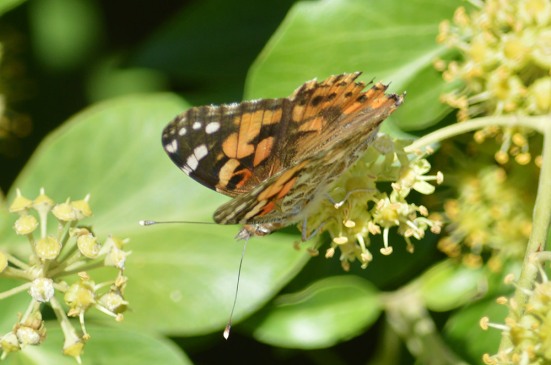
Painted lady

Vanessa cardui ~ Painted lady ~ Stričkovac

This photograph was taken at Vorh on Hvar, altitude around 500 metres. European ivy is known for having flowers high in nectar, and was swarming with butterflies and bees in September. The Painted lady migrates from North Africa and the Mediterranean northwards in the springtime, and southwards in the autumn. The 9,000 mile round trip between tropical Africa and the Arctic circle may take as many as 6 generations! Was this butterfly on a refuelling stop for its Autumn migration?

This summer I’ve been more aware of butterflies on Hvar, possibly due to my recent interest in wildflowers. It’s a good sign, as flowers and butterflies mean a healthy ecosystem. Though sometimes they were nowhere near any flowers!
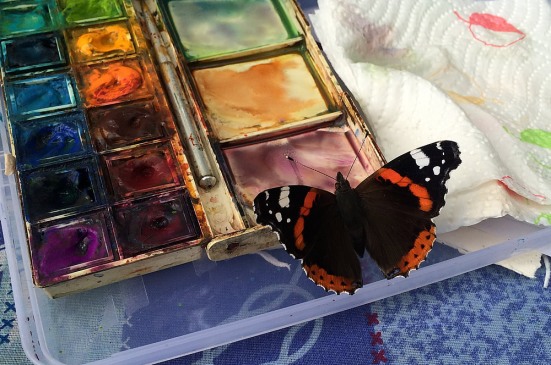
Red admiral

Vanessa atalanta ~ Red Admiral ~ Ljepokrili admiral

As I was sitting on the Soline beach near Vrboska, painting with my art group, this visitor was very interested in my paintbox! Luckily I had my phone to hand, and managed to capture the moment! And as I didn’t really feel that paints were proper nourishment, being toxic and all, I closed up the box, so it decided to try some wine instead!
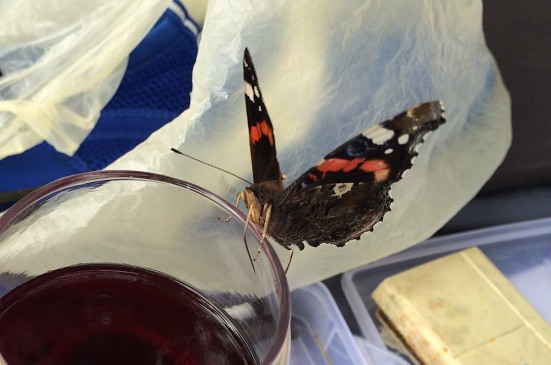
Red admiral likes a glass of wine

My Red admiral likes a glass of wine!

While some (adult) butterflies live only for a few days, other species survive for almost a full year. Those living longer can feed on nectar from flowers, and they are in fact important pollinators for some kinds of plants. Although they can’t carry as much pollen as bees, they are able to take it over longer distances. They’ll also sip water (and wine!), are sometimes  attracted to dung, rotting fruit, or the salt in human sweat for other essential minerals and nutrients. Their “taste” receptors are apparently located on their feet, so they can determine whether a leaf is suitable for laying eggs on (ie the caterpillar kids can eat it!)
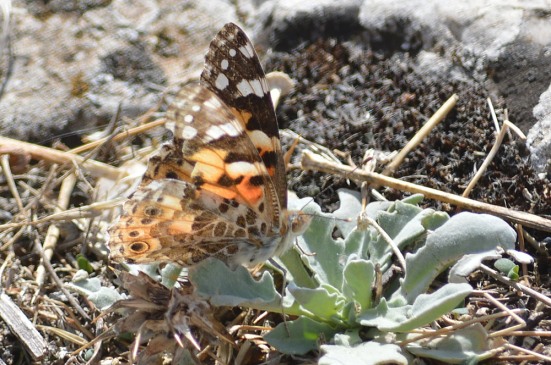
Red admiral underside

Red admiral underside

I spotted this Red admiral near the peak of Sv Nikola, up in the high country (628 metres). Good view of the underside of the wing. Red admirals also migrate, spending summer in northern Europe, and winter near the Mediterranean.

In Croatian, a butterfly is called a leptir, for once easy to remember as it’s clearly related to lepidoptera (from the ancient Greek  lepís=scale + pterón=wing). It’s less certain why the English saw any association with butter, though the name has been around for some time in old Dutch and German. Were there only yellow butterflies in northern Europe, I wonder?
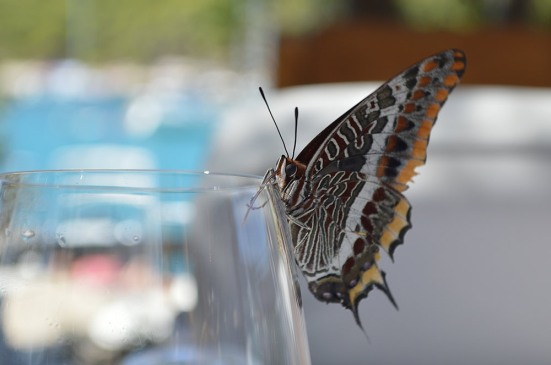
Two-tailed pasha also going for my wine

Charaxes jasius ~ Two-Tailed Pasha ~ vještica

Another butterfly that was keen to share our wine was this Two-tailed Pasha with exceptional taste at restaurant Laganini on Palmižana! It did, in fact, take a dive headfirst into my glass and had to be rescued at the expense of the wine!
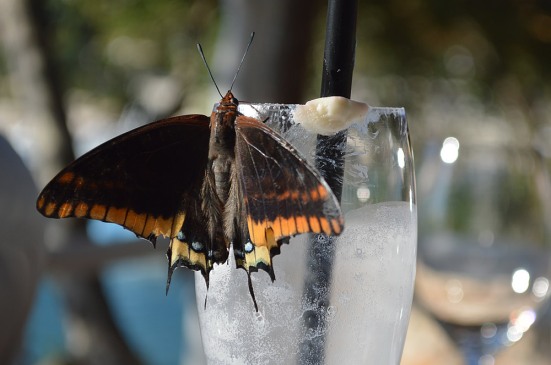
Two-tailed pasha

Two-Tailed Pasha enjoying some lemon sorbet

A fine butterfly, and a great poser with his proboscis stuck into a drop of lemon sorbet (with vodka and prosecco) for a good long drink! Two-tailed pashas produce two generations in a season, flying May/June and August/October. Clearly, they also like a drink!
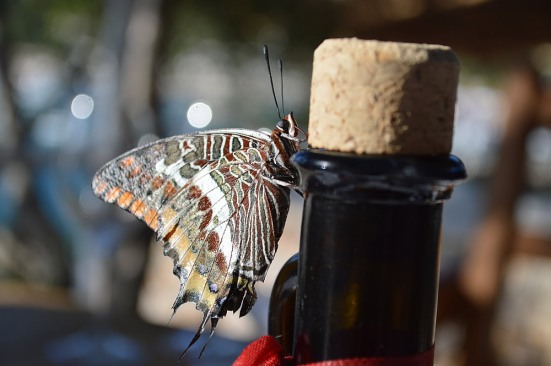
Two-tailed pasha underside

Two-tailed pasha underside and clear view of head

The beautiful colour of butterfly wings is due to the scales. While the dark blacks and browns are melanin pigments, and yellows come from uric acid and flavones, the other bright blues, greens, reds and iridescence are all caused by the structure of the scales and hairs.
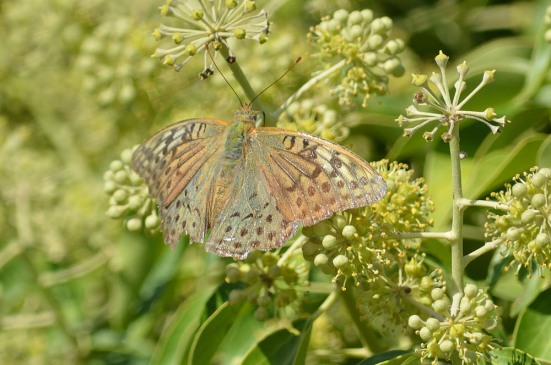
Cardinal

Argynnis pandora ~ Cardinal ~ Pandorin šarenac

Meanwhile, back at the popular ivy flowers, was this lovely Cardinal which is a fairly common butterfly around southern Europe from April to September. Sadly the photograph doesn’t quite do justice to the shimmer of that pale green colour. Very pretty in real life!
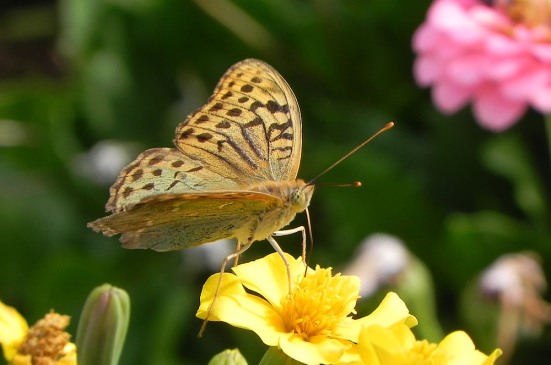
Cardinal in Stari Grad

Cardinal in Stari Grad

The second Cardinal was spotted in a garden in Stari Grad. Good view of the antennae, and the proboscis stuck into the flower. It looks to have only 4 legs, but that’s apparently normal for some types of butterflies, the front two legs are much reduced.
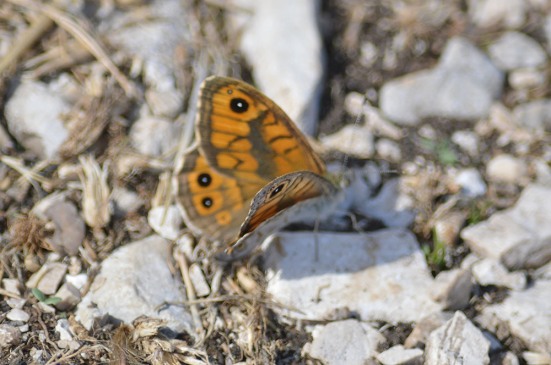
Wall brown

Lasiommata megera ~ Wall Brown ~ mali pjegavac

Hmmm, the field notes say the Wall brown is very alert and difficult to approach for taking photos – well, that’s certainly true! This guy was spotted beside the path on the way up to Sv Nikola, and this is the best photograph I could manage!

A recent (2011-13) study of butterflies on Hvar recorded 49 species, some of which are very rare within Croatia. All in all, 57 species have been recorded on Hvar, giving it 4th place among the islands for butterfly diversity. I have a long way to go to spot all those!

“Happiness is a butterfly, which when pursued, is always just beyond your grasp, but which, if you will sit down quietly, may alight upon you.”
~ Nathaniel Hawthorne

© Marion Podolski 2016

More about Croatia’s butterflies:

Project Noah: Butterflies and Moths of Croatia

Euro Butterflies by Matt Rowlings

Wikipedia list of butterflies and moths in Croatia

Annoted list of Croatian butterflies with vernacular names (PDF file for download)

Contribution to the knowledge of the butterfly fauna on the Adriatic island of Hvar, Croatia

This article has been reproduced with kind permission from Marion's blog Go Hvar, Ramblings about a far island. Visit the blog for all kinds of information about Hvar, from artistic to epicurean!

You are here: Home Nature Watch Hvar's Butterflies

Eco Environment News feeds

  • Exclusive: Economic harm of CO2 pollution from Rosebank and Jackdaw forecast to far outweigh any boost to UK

    The climate damage caused by developing the Rosebank and Jackdaw oil and gas fields under consideration by the UK government would destroy their economic benefits many times over, according to an analysis.

    It estimates the economic damage caused by the carbon pollution from the oil and gas produced would be between £119bn and £336bn in the coming decades, compared with the £28.7bn in value to the UK estimated by Adura, the fossil fuel company promoting the new fields.

    Continue reading...

  • A local initiative is testing simple ways to stop algal blooms in the River Fal threatening some of England’s most biodiverse marine habitats

    On a rocky beach in Cornwall, a group of wetsuit-clad freedivers and snorkellers are wading into the shallows. Below St Mawes Castle, built by Henry VIII to defend Falmouth harbour, they disappear in a swish of florescent pink and green fins.

    They are volunteers, trained by the Cornwall Wildlife Trust to use underwater cameras and floating GPS devices to detect changes in marine habitats over time.

    Two volunteers, Simon Tagney and Max Behnert, prepare to survey the seabed beneath the 16th-century St Mawes Castle. Photograph: Luke Gartside/The Guardian

    Continue reading...

  • Ynys Môn (Anglesey): The rosy footman is a relative newcomer to this part of Wales, bringing with it nectarine tones and markings like hieroglyphs

    I have a routine in the summer months that I like to keep to as often as I can. That is, to start my day in the company of moths.

    This morning, after a gentle night  – too cloudy to see the flight of Perseid meteors but mild enough to encourage the flight of moths – I head out to my Robinson light trap. It’s 40 years old and somewhat shabby, and sits between the meadow plots in our wildlife garden like a tiny flying saucer. With cuppa to hand, and joined by our familiar robin, who knows this routine well, I examine the live catch.

    Continue reading...

  • Henry Astor looked back to his grandfather’s time for the inspiration to find older varieties that could help nature on his Cotswold farm

    It is the earliest harvest Henry Astor can remember. But walking through the scorched wheatfields of his Cotswolds farm, signs of life are everywhere – swarms of insects, kaleidoscopic wildflower meadows, bushy hedgerows several metres wide. A yellowhammer perches on a nearby tree.

    There are 18 other red-listed birds on the farm, says Astor, who this year ringed 23 barn owls, three kestrels, two little owls as well as goshawk chicks. “Last winter we had clouds of goldfinch, chaffinch and greenfinch,” he says. Britain has lost 73 million birds since 1970; but at Bruern Farms, a small but welcome reversal is taking shape.

    Continue reading...

  • True figure likely to be much higher as it only covers about half of continent and does not include August totals

    At least 35,000 more people died during Europe’s four record-breaking, back-to-back heatwaves this summer than would normally be expected, according to incomplete figures from barely half the continent.

    Excess mortality in three of the EU’s larger countries – Germany, France and Spain – alone has already exceeded 25,000, according to the provisional national figures, and experts say the toll will rise significantly once August totals are consolidated.

    Continue reading...

  • Rise in claims linked to heat-related deaths and illness, especially among older people, could drive up premiums

    Europe’s intense heatwaves could hit insurers’ earnings as companies face a rise in claims linked to heat-related deaths and worsening health conditions, the rating agency S&P has said.

    While a long summer of extreme heat will have increased drought and wildfire-related claims, the rating agency said there would also be fallout for life and health insurers, and for the reinsurers who provide financial protection to insurance companies.

    Continue reading...

  • Hélène Duguy is taking on companies accused of failing to stop Pfas pollution in the area of France she calls home

    The factories were just part of the landscape for Hélène Duguy growing up in the heart of an area known as France’s “Chemical Valley”.

    “Those factories are visible from my mother’s apartment,” says Duguy, 34, whose mother still lives in St-Genis-Laval, south of Lyon.

    Continue reading...

  • There are countless initiatives around the world that can inspire people and spur them into action. Amid the devastation of the climate crisis, our journalists strive to highlight these stories of hope

    The news is very often about the bad things (especially if you’re on the Guardian’s environment desk). Wildfires, floods, tipping points, billionaires making huge profits and buying themselves island refuges for the apocalypse … And yet, ticking along beside that is the steady pulse of what the rest of humanity is doing in response to the climate crisis. From housing developments with no cars to buildings made out of hemp, all over the planet, people are ploughing ahead and changing their neighbourhoods and cities and world.

    But as news stories typically need to be about new developments or things people didn’t previously know about, it can be hard to cover all those brilliant initiatives being undertaken in the background – no matter how cheering they are. Which is why, back in 2023, we decided to ignore the usual rules about what constitutes “news” and start writing about them anyway. Readers, we knew, would like to hear about them.

    Climate campaign 2026: help us reach 30,000 acts of support

    Continue reading...

  • MVRDV – the firm behind Marble Arch Mound – says Rotterdam ROCKS! will inspire visitors to live sustainably. But in an era when the greenest building is the one that already exists, this tottering cairn looks set to misfire

    ‘It looks like something Shrek would throw up,” sniffed one online commentator, unflatteringly comparing Rotterdam ROCKS!, the recently unveiled proposal for a waterfront site in Europe’s largest port, with the vomitings of a cartoon ogre. Designed by Dutch architectural firm MVRDV, which gave London the supremely underwhelming Marble Arch Mound in 2021, Rotterdam ROCKS! (the use of EMPHATIC CAPITALS connoting an in-your-face energy) is the winner of a major architectural competition intended to create “a new world wonder”.

    But instead of a modern Hanging Gardens of Babylon or contemporary Colossus of Rhodes, MVRDV’s super slick renderings depict a pile of artificial “rocks” (or ROCKS!) stacked together in a humongously scaled tottering cairn, wreathed in suspiciously luxuriant foliage and sluiced by a preposterous waterfall.

    Continue reading...

  • New documentary To Use a Mountain spotlights the pain and triumph of resisting government efforts to turn parts of rural US into disposal sites

    Nuclear energy was supposed to be our salvation, humanity’s chance to retool technology first conceived as a weapon of mass destruction into an engine of limitless prosperity. But even as the industry touted nuclear fission as an economic game-changer (never mind the astronomical startup costs), a safety paragon (never mind the spills at Chornobyl, Three Mile Island and Fukushima) and harmless fodder for an American comedy institution (never mind that glowing rod on Homer’s back or the three-eyed fish), there was no getting around the matter of what to do with all the toxic waste (never mind nuclear’s claimed green credentials).

    The stagnant state of that dirty business brought Casey Carter, the director of the new avant-garde documentary called To Use a Mountain, back to his interview with a Washington state farmer who was part of a class-action lawsuit against the government over the release of radioactive material from the Hanford nuclear reservation – site of the world’s first full-scale plutonium production reactor. The farmer’s words still echo, despite ultimately being cut to fit the film’s 90-minute runtime. “He joked that nuclear power is the only faith-based energy because everyone always asks, ‘Do you believe in it?’” Carter says. “He was like, ‘You don’t have to believe in solar. It’s just a pretty good idea.’”

    Continue reading...

Eco Health News feeds

Eco Nature News feeds