Hvar's Butterflies

Marion Podolski casts her expert artistic eye over Hvar's butterflies.

Hvar butterfly at work, July 2016 Hvar butterfly at work, July 2016 Vivian Grisogono

Butterflies always seem so fragile, so transient. So it came as quite the surprise when I read that (a) there are butterfly fossils dating back around 56 million years, and (b) the Painted Lady appears to hold the record for the longest return migration, from Africa to the Arctic circle and back!
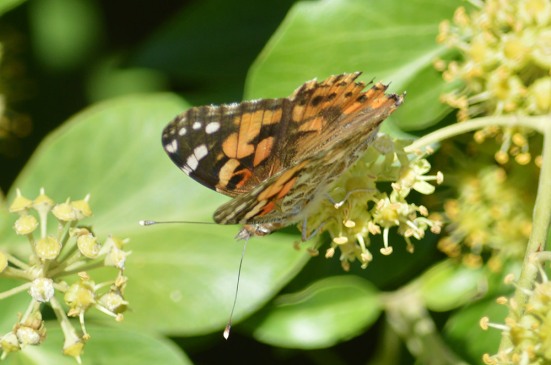
Painted lady

Vanessa cardui ~ Painted lady ~ Stričkovac

This photograph was taken at Vorh on Hvar, altitude around 500 metres. European ivy is known for having flowers high in nectar, and was swarming with butterflies and bees in September. The Painted lady migrates from North Africa and the Mediterranean northwards in the springtime, and southwards in the autumn. The 9,000 mile round trip between tropical Africa and the Arctic circle may take as many as 6 generations! Was this butterfly on a refuelling stop for its Autumn migration?

This summer I’ve been more aware of butterflies on Hvar, possibly due to my recent interest in wildflowers. It’s a good sign, as flowers and butterflies mean a healthy ecosystem. Though sometimes they were nowhere near any flowers!
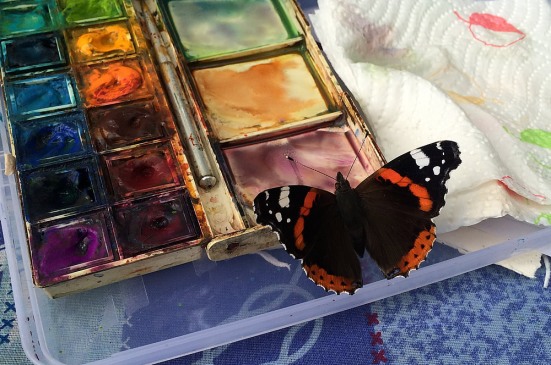
Red admiral

Vanessa atalanta ~ Red Admiral ~ Ljepokrili admiral

As I was sitting on the Soline beach near Vrboska, painting with my art group, this visitor was very interested in my paintbox! Luckily I had my phone to hand, and managed to capture the moment! And as I didn’t really feel that paints were proper nourishment, being toxic and all, I closed up the box, so it decided to try some wine instead!
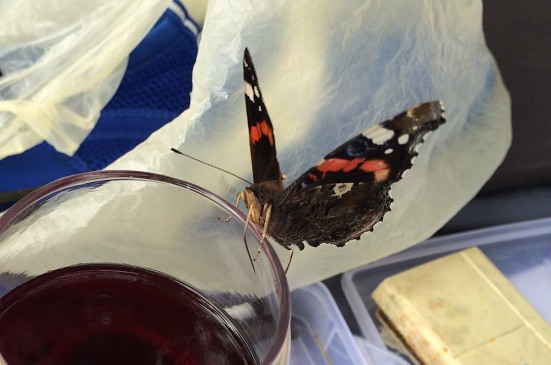
Red admiral likes a glass of wine

My Red admiral likes a glass of wine!

While some (adult) butterflies live only for a few days, other species survive for almost a full year. Those living longer can feed on nectar from flowers, and they are in fact important pollinators for some kinds of plants. Although they can’t carry as much pollen as bees, they are able to take it over longer distances. They’ll also sip water (and wine!), are sometimes  attracted to dung, rotting fruit, or the salt in human sweat for other essential minerals and nutrients. Their “taste” receptors are apparently located on their feet, so they can determine whether a leaf is suitable for laying eggs on (ie the caterpillar kids can eat it!)
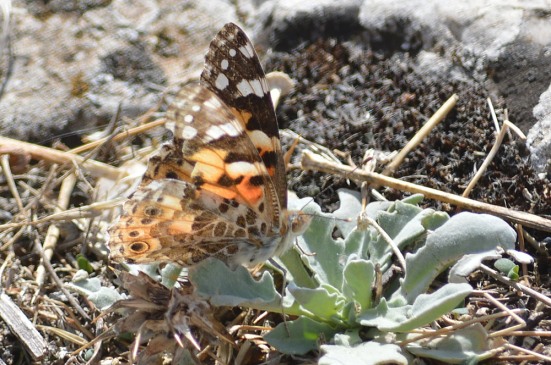
Red admiral underside

Red admiral underside

I spotted this Red admiral near the peak of Sv Nikola, up in the high country (628 metres). Good view of the underside of the wing. Red admirals also migrate, spending summer in northern Europe, and winter near the Mediterranean.

In Croatian, a butterfly is called a leptir, for once easy to remember as it’s clearly related to lepidoptera (from the ancient Greek  lepís=scale + pterón=wing). It’s less certain why the English saw any association with butter, though the name has been around for some time in old Dutch and German. Were there only yellow butterflies in northern Europe, I wonder?
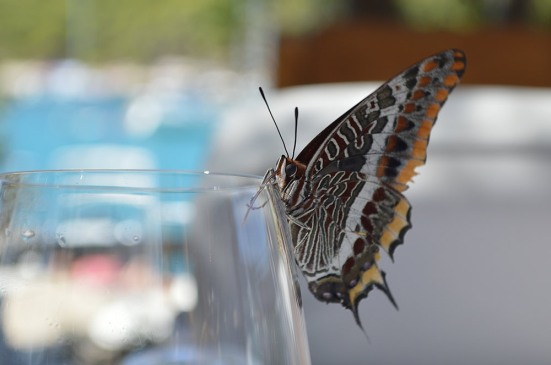
Two-tailed pasha also going for my wine

Charaxes jasius ~ Two-Tailed Pasha ~ vještica

Another butterfly that was keen to share our wine was this Two-tailed Pasha with exceptional taste at restaurant Laganini on Palmižana! It did, in fact, take a dive headfirst into my glass and had to be rescued at the expense of the wine!
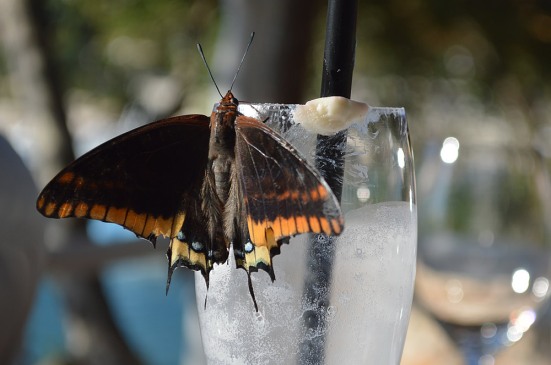
Two-tailed pasha

Two-Tailed Pasha enjoying some lemon sorbet

A fine butterfly, and a great poser with his proboscis stuck into a drop of lemon sorbet (with vodka and prosecco) for a good long drink! Two-tailed pashas produce two generations in a season, flying May/June and August/October. Clearly, they also like a drink!
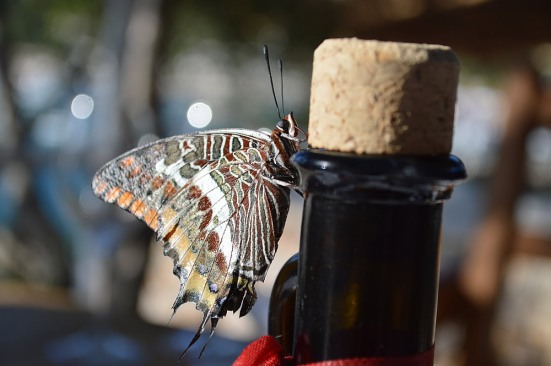
Two-tailed pasha underside

Two-tailed pasha underside and clear view of head

The beautiful colour of butterfly wings is due to the scales. While the dark blacks and browns are melanin pigments, and yellows come from uric acid and flavones, the other bright blues, greens, reds and iridescence are all caused by the structure of the scales and hairs.
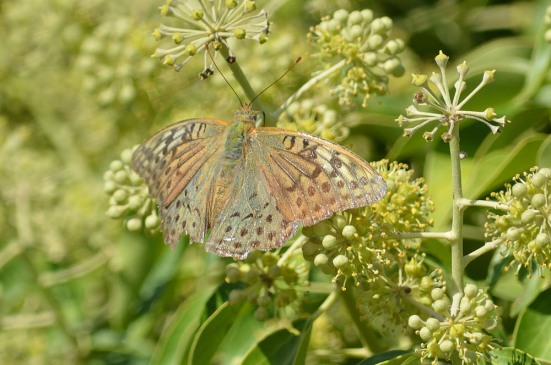
Cardinal

Argynnis pandora ~ Cardinal ~ Pandorin šarenac

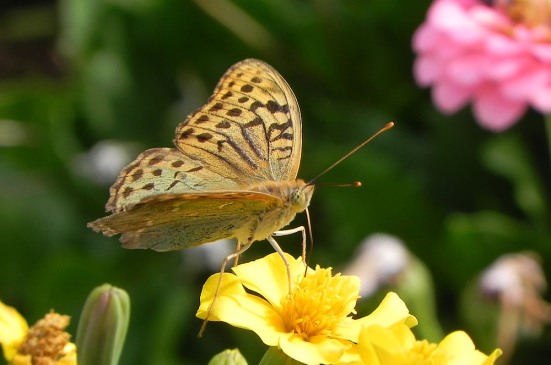
Meanwhile, back at the popular ivy flowers, was this lovely Cardinal which is a fairly common butterfly around southern Europe from April to September. Sadly the photograph doesn’t quite do justice to the shimmer of that pale green colour. Very pretty in real life!
Cardinal in Stari Grad

Cardinal in Stari Grad

The second Cardinal was spotted in a garden in Stari Grad. Good view of the antennae, and the proboscis stuck into the flower. It looks to have only 4 legs, but that’s apparently normal for some types of butterflies, the front two legs are much reduced.
Wall brown

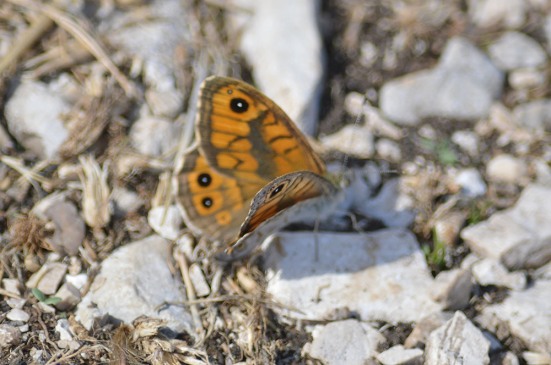
Lasiommata megera ~ Wall Brown ~ mali pjegavac

Hmmm, the field notes say the Wall brown is very alert and difficult to approach for taking photos – well, that’s certainly true! This guy was spotted beside the path on the way up to Sv Nikola, and this is the best photograph I could manage!

A recent (2011-13) study of butterflies on Hvar recorded 49 species, some of which are very rare within Croatia. All in all, 57 species have been recorded on Hvar, giving it 4th place among the islands for butterfly diversity. I have a long way to go to spot all those!

“Happiness is a butterfly, which when pursued, is always just beyond your grasp, but which, if you will sit down quietly, may alight upon you.”
~ Nathaniel Hawthorne

© Marion Podolski 2016

More about Croatia’s butterflies:

Project Noah: Butterflies and Moths of Croatia

Euro Butterflies by Matt Rowlings

Wikipedia list of butterflies and moths in Croatia

Annoted list of Croatian butterflies with vernacular names (PDF file for download)

Contribution to the knowledge of the butterfly fauna on the Adriatic island of Hvar, Croatia

This article has been reproduced with kind permission from Marion's blog Go Hvar, Ramblings about a far island. Visit the blog for all kinds of information about Hvar, from artistic to epicurean!

You are here: Home Nature Watch Hvar's Butterflies

Eco Environment News feeds

  • Hélène Duguy is taking on companies accused of failing to stop Pfas pollution in the area of France she calls home

    The factories were just part of the landscape for Hélène Duguy growing up in the heart of an area known as France’s “Chemical Valley”.

    “Those factories are visible from my mother’s apartment,” says Duguy, 34, whose mother still lives in St-Genis-Laval, south of Lyon.

    Continue reading...

  • Poll also finds sizeable majorities who believe it should be easier to install air con in homes

    Given the choice, more people across six major European nations including the UK favour encouraging the adoption of air conditioning over keeping carbon emissions down, a survey has found.

    After four extreme heatwaves that have caused thousands of excess deaths across the continent, the survey showed between 30% and 52% of people in six countries had feared for their household’s health in temperatures close to or above 40C (104F).

    Continue reading...

  • Phillip Island’s ‘iconic’ little penguins get first bird flu vaccinations in what is thought to be largest program of its kind

    More than 1,000 little penguins have received their first dose of bird flu vaccine in Victoria, in what is believed to be the world’s largest vaccination program involving wild birds.

    Catherine Basterfield, the chief executive of Phillip Island Nature Parks, said vaccinations began early last week and were ramping up.

    Continue reading...

  • Pair are offspring of two beavers who mysteriously arrived in Pensthorpe nature reserve near Fakenham in December

    Wild beaver kits have been born in Norfolk for the first time in more than 500 years.

    The pair of newborns are the offspring of two free-living beavers who mysteriously arrived in Pensthorpe nature reserve near Fakenham in December.

    Continue reading...

  • Tylorstown, Rhondda Valley: These coal areas are shaped by fire and ash. I find a high point to try and survey the damage

    My friend John and I are climbing Tylorstown Tip – a summit also known as Old Smokey, named after the hot ash it was partly made with. We want to see how much of south Wales has burned.

    The tip towers over the surrounding hills, a perfect crow’s nest from which to witness the blackening of the region. From the summit, with its sitka spruce and flowering heather, the expanse of St Gwynno’s forest spreads out before us, all 6,533 acres of it. Browned, dead plantation forestry gives way to grassland burned to cinder. A veil of smoke lies above the forest for miles.

    Continue reading...

  • Farmer Derek Sayer let a boggy field run wild and just one annual hay-cut has led to remarkable biodiversity

    Tucked away on a country lane, a small field bursts with yellow and pink flowers. Quail and whitethroats call from the thick hedges and the plants, including common centaury, yellow rattle and marsh and common spotted orchids, bounce with hoverflies and butterflies.

    More than 150 plant species have been recorded on Sayer’s Old Meadow, in north Norfolk, England, which is remarkable when there was just one – oilseed rape – growing there 21 years ago.

    Continue reading...

  • Similar initiatives have been launched from Barcelona to Bogotá, but they have misinformation, political pressure and vested interests stacked against them

    Ten years ago, Alastair Harper was an advocate for young people’s health sitting in a stuffy meeting room in London planning an air pollution campaign. “My phone started buzzing,” he said. “I took the call, and then told the room I needed to leave immediately.

    “I had to get to UCLH [one of London’s major hospitals]. My own child was headed there in a blue-lit ambulance because she was struggling to breathe London’s toxic air.”

    Continue reading...

  • Henry Astor looked back to his grandfather’s time for the inspiration to find older varieties that could help nature on his Cotswold farm

    It is the earliest harvest Henry Astor can remember. But walking through the scorched wheatfields of his Cotswolds farm, signs of life are everywhere – swarms of insects, kaleidoscopic wildflower meadows, bushy hedgerows several metres wide. A yellowhammer perches on a nearby tree.

    There are 18 other red-listed birds on the farm, says Astor, who this year ringed 23 barn owls, three kestrels, two little owls as well as goshawk chicks. “Last winter we had clouds of goldfinch, chaffinch and greenfinch,” he says. Britain has lost 73 million birds since 1970; but at Bruern Farms, a small but welcome reversal is taking shape.

    Continue reading...

  • The Democratic and the Republican candidate each blame the other for the bungled recovery effort after storm struck region

    Two years after North Carolina suffered the worst natural disaster in its history when Hurricane Helene struck the state’s western half, life in the hardest-hit areas appears back to normal. Downtowns are lively, blocked roads have been reopened and rivers are flowing below their banks.

    But the telltale evidence of the disaster’s expensive impacts can still be seen – from “for rent” signs in storefronts whose businesses never came back to debris from the storm still lurking in some waterways. And in the race for North Carolina’s US Senate seat, it’s almost as if the hurricane never left.

    Continue reading...

  • With limited electricity and poor ventilation, many families in Nasirabad have little to shield them from temperatures of up to 50C

    As the first light reaches Nasirabad, a queue of men, women and children has already formed outside the town’s ice factory, with their buckets, sacks and plastic containers. Among those hoping to buy some ice to help their families endure another scorching day is 12-year-old Taimoor, in his school uniform. He says it is his most important task of the day.

    “If I do not bring the ice, how will we endure the heat at home?” he says. “And how will we drink water that feels as though it is boiling?”

    Continue reading...

Eco Health News feeds

Eco Nature News feeds